Studio Visit:
Alia Farid

The studio of Kuwaiti-Puerto Rican artist Alia Farid has rarely been one fixed site but rather a constellation of places, collaborators and conversations. Moving between the Gulf and the Caribbean, she has built a practice in which ideas emerge through immersion in place and culture

Words May Makki 
Photography Abdulaziz Alrabea

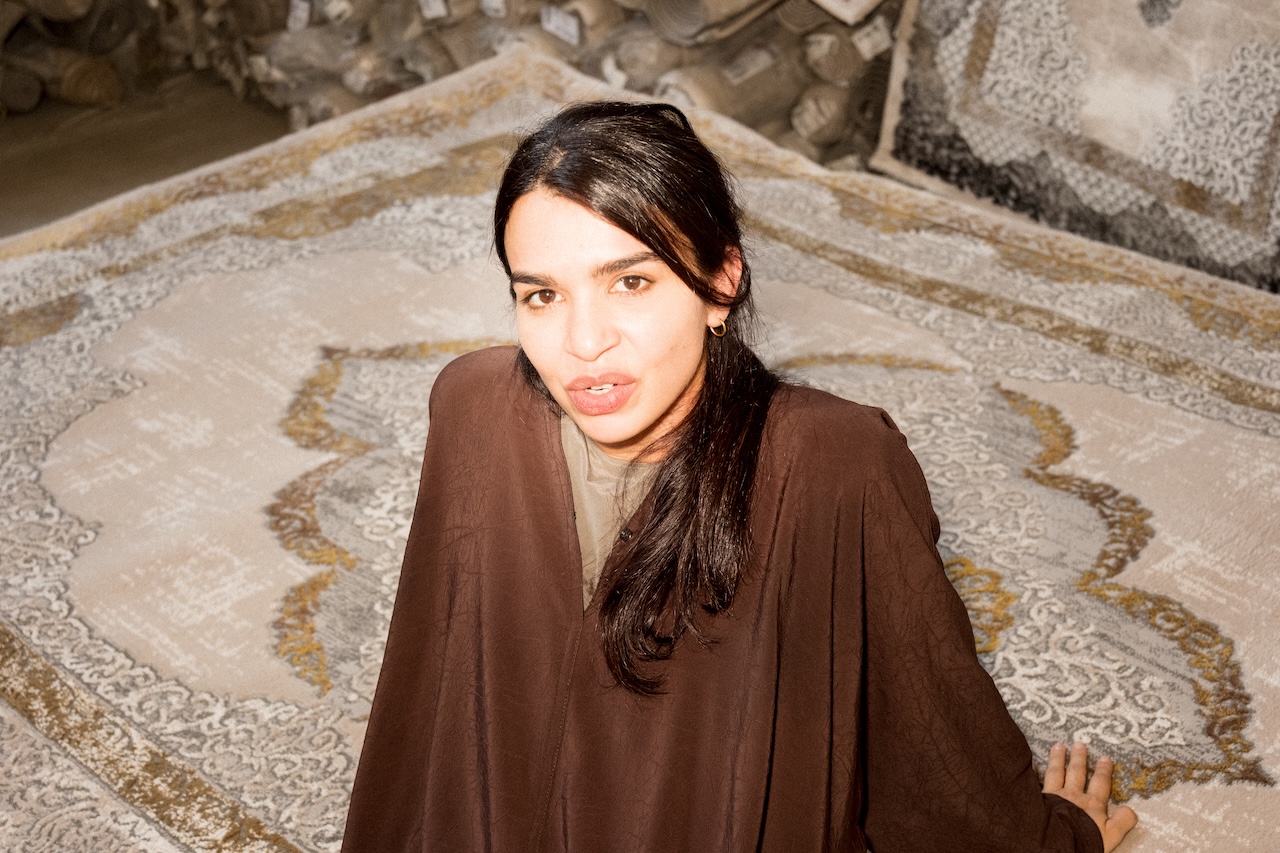
A person with long dark hair, wearing a brown outfit, sits on a patterned rug with rolled carpets in the background
Kuwaiti-Puerto Rican artist Alia Farid on woven carpets at the Friday Market, Kuwait
There is no single place to visit Alia Farid’s studio. Speaking from her family home in Kuwait, Farid shares her screen with a spreadsheet cataloguing the tapestries in her ongoing project, Elsewhere, by country, establishment and edition number. The series, which started modestly in 2013 as a documentation project, today comprises 181 textile pieces. Intricately workshopped and woven in collaboration with a collective in southern Iraq, the tapestries draw on photographs, documents and oral histories collected by Farid that trace the persistence of Arab and south Asian identity across the Caribbean. The comprehensive spreadsheet, while less visually impressive than the textiles, is just as remarkable, revealing itself to be a map of relationships accumulated over more than a decade.

Farid’s studios have rarely been permanent, instead emerging around the immediate needs of one project before giving way to the next: in Kuwait, her studio has been a dressing room in Alfred Roth’s abandoned modernist school in the city of Hawally, a live/ work space in an IM Pei building in Bneid Al Gar, and now the third floor of her family home. In Puerto Rico, she has begun renovating a workspace in a building designed by Edward Larrabee Barnes, although she hesitates to call it a conventional studio. “It’s a thinking studio – a place where I can gather my thoughts, read, organise myself,” she explains. Kuwait, by contrast, remains “the production-heavy side of things”.

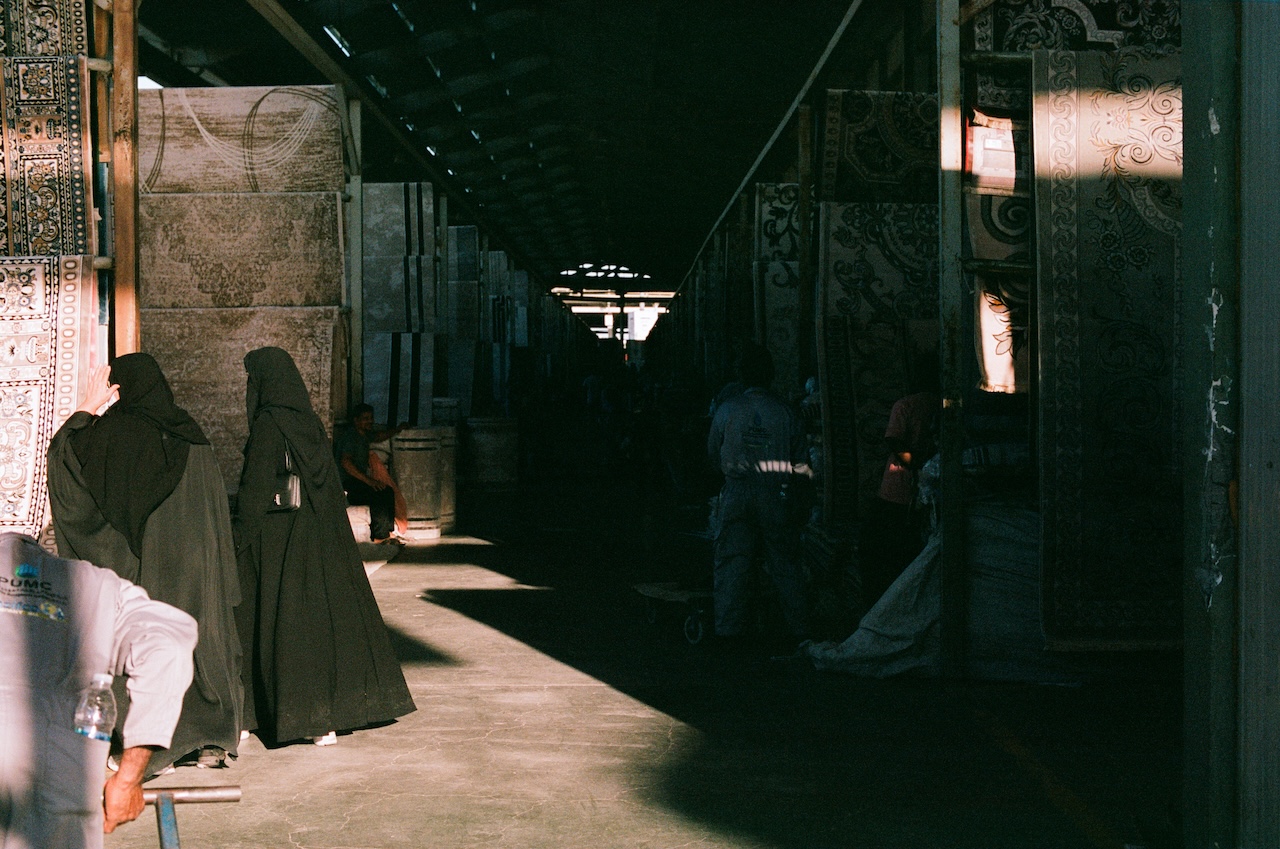
People walk through a dimly lit market corridor lined with large hanging carpets. Beams of sunlight highlight parts of the scene, casting dynamic shadows. Some people wear dark traditional clothing, adding to the atmospheric allure.
The carpet section of the market, where Farid often finds inspiration for her work
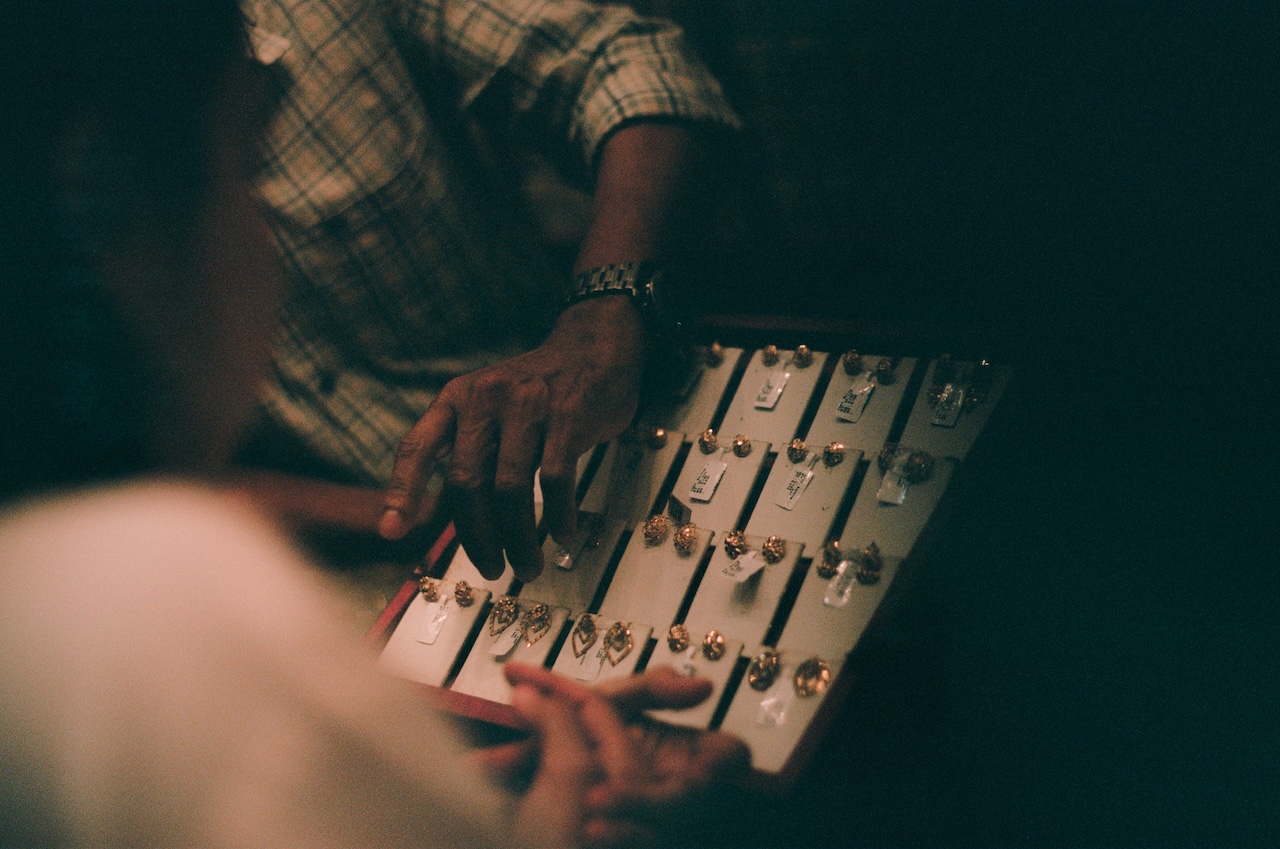
A person’s hand points at a display tray of various rings, possibly gold, while another person observes. The scene appears dimly lit, suggesting an intimate or indoor setting
Farid at a gold store in Fahaheel, Kuwait. “Gold is interesting to me as a measure of value, because of how war affects its price,” she says. “We are in times of war.”

Although Kuwait and Puerto Rico are separated by thousands of miles, Farid moves between the two countries according to the requirements of her work. She is perhaps most recognised for her resin receptacles – including Jerican, 2026, which was recently on view at the Qatar Pavilion for the 61st International Art Exhibition of the Venice Biennale – that can only be produced outdoors because of the toxicity of the material, making the Kuwaiti desert an essential site of production.

As such, Farid’s studio is sometimes simply a corner of the resin factory where she is free to bring in the objects she collects, live among them for a time, and think with them before translating them into sculpture. Otherwise, she organises her time around periods of research and forthcoming exhibitions, spending extended stretches in Puerto Rico when working in the Americas and returning to Kuwait when projects take her to Europe or other parts of Asia. Farid describes this approach as “just-in-time” art-making, producing only what a particular work demands, in the quantities it requires, and keeping only what is essential.

“I work very slowly,” says Farid. She recalls her mother worrying because, as a young child, she was slow to start speaking. Then one day, she says, she suddenly uttered a whole sentence. The story has become an unlikely metaphor for the way Farid works. Rather than charging at a clearly articulated thesis, she starts with an intuition, follows it patiently and only later understands where it has led. “It’s mostly in hindsight that I’m able to describe what I was doing,” she explains.

This methodology is perhaps most evident in Elsewhere. Initially, she was drawn to instances of visual dislocation she observed in Puerto Rico, such as slippages between Arabic and Spanish in commercial signs. These visual cues became a jumping-off point for considering the Palestinian diaspora and the particular hybrid identity that has formed and leaves traces in the built environment. The project emerges against the backdrop of longstanding solidarities between Puerto Rican and Palestinian liberation movements, built on parallels between Israeli occupation and US militarisation of Puerto Rico. Farid, however, probes the largely untold history of the Palestinian diaspora and the forms of identity produced within this context.

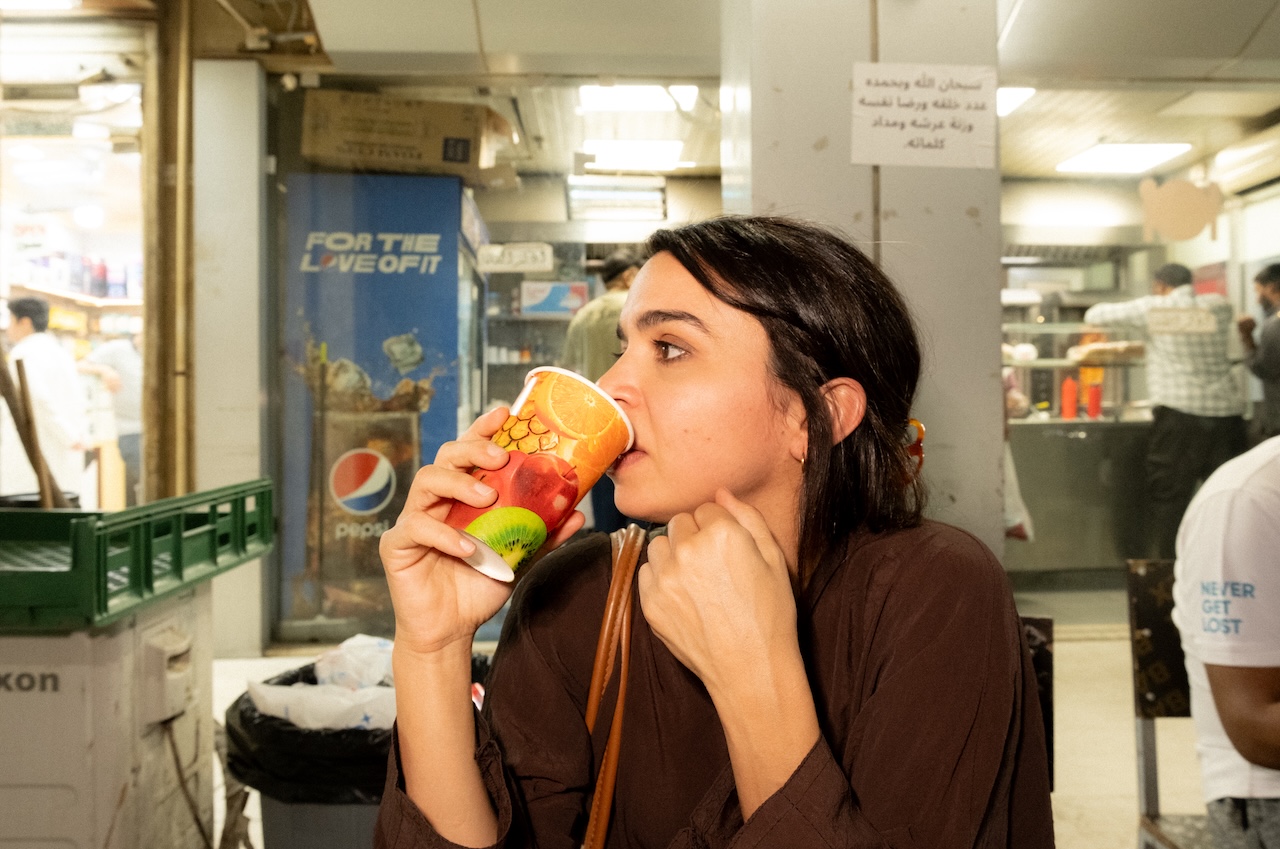
A woman with dark hair sips a drink from a colorful cup with fruit images, sitting at an outdoor food stall at night. The background shows a Pepsi sign and people working in a shop
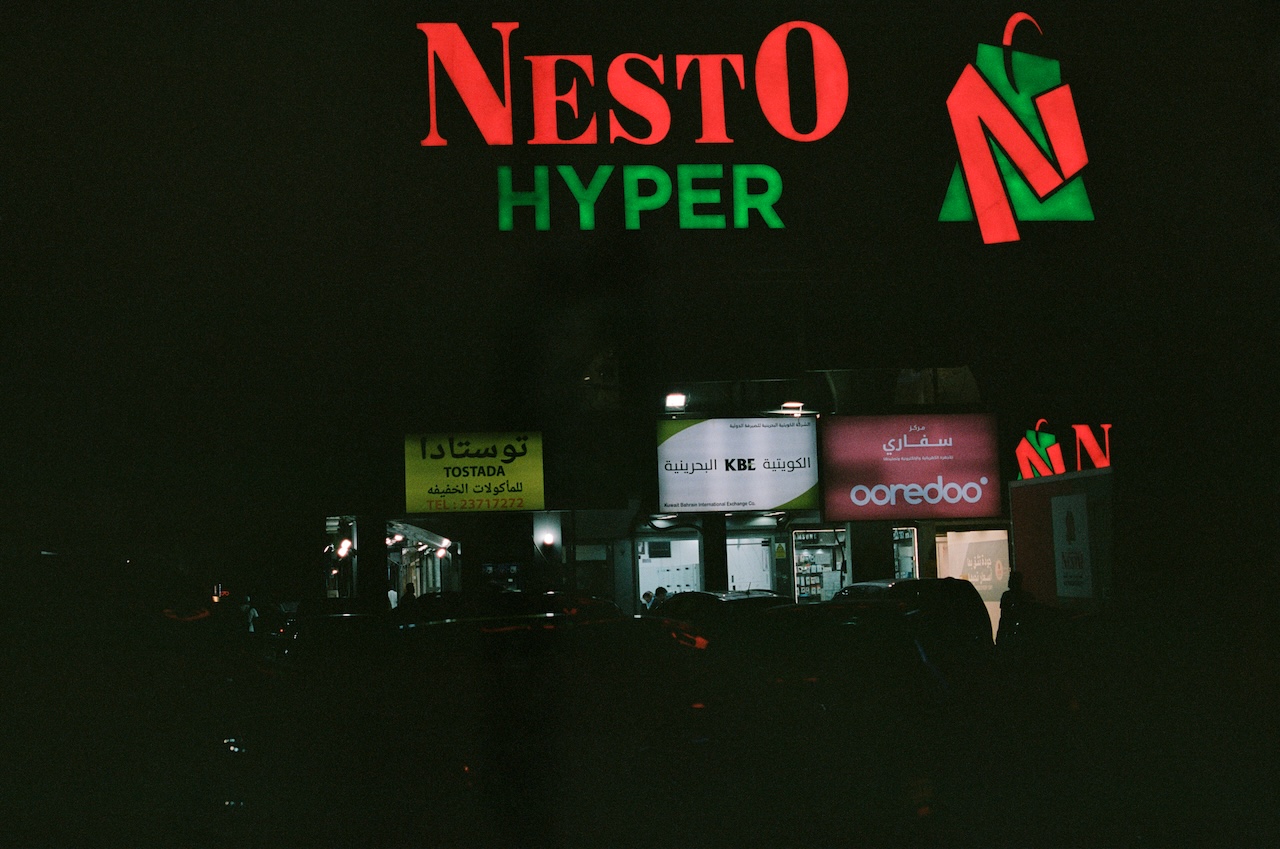
Farid in front of a small snack shop in Mangaf, Kuwait, which features signage that reads “Tostada” in both Arabic and Spanish – a detail that resonates with the way Farid’s work explores language and translation
A night scene shows illuminated signs for Nesto Hyper in red and green above smaller storefront signs, including Ooredoo, KBE, and one in Arabic. Dark vehicles are parked in front, lending an urban atmosphere
Other similar store fronts and signage around the shop
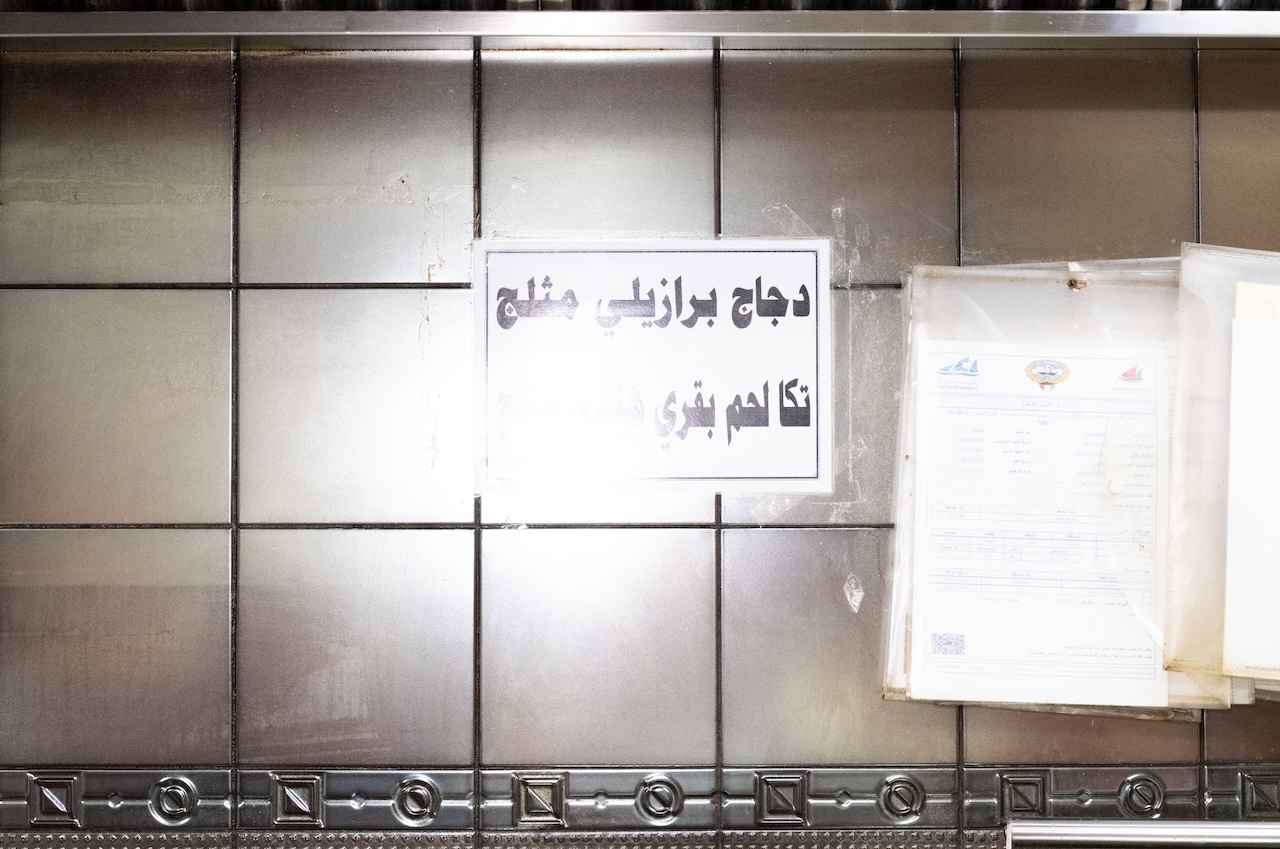
A tiled wall with a sign in Arabic above some papers. The sign is partially obscured by glare, making it hard to read clearly. The area appears clean and industrial, possibly part of a kitchen or food service area
A sign inside Tostada that reads “Frozen Brazilian Chicken” in Arabic

Wherever Palestinians live without the right to return, whether a two-hour drive away in Lebanon or thousands of miles away in Puerto Rico, Palestine often assumes a mythic dimension. At once it is a homeland remembered, imagined and reconstituted from a distance. In Farid’s work, this tension surfaces in unexpected ways, such as the mosque she encountered in southern Puerto Rico, whose outsized arch and minaret amplify Arab-Islamic forms beyond their original context, as well as in quieter objects like restaurant menus and family photographs.

A grant that Farid received in 2022 allowed her to undertake the intensive social work the ambitious project demanded. She spent months cold-calling people, following introductions and building an archive of photographs, menus, letters and oral histories across Arab communities in the Caribbean and Latin America. At first, many were reluctant to talk but as trust grew and word spread through the community, the archive organically expanded. “Once somebody says yes, and they vouch for you, that opens doors,” Farid explains. She’s since expanded into Cuba and the Dominican Republic, and the scope has evolved to look at Arab and south Asian migration more expansively.

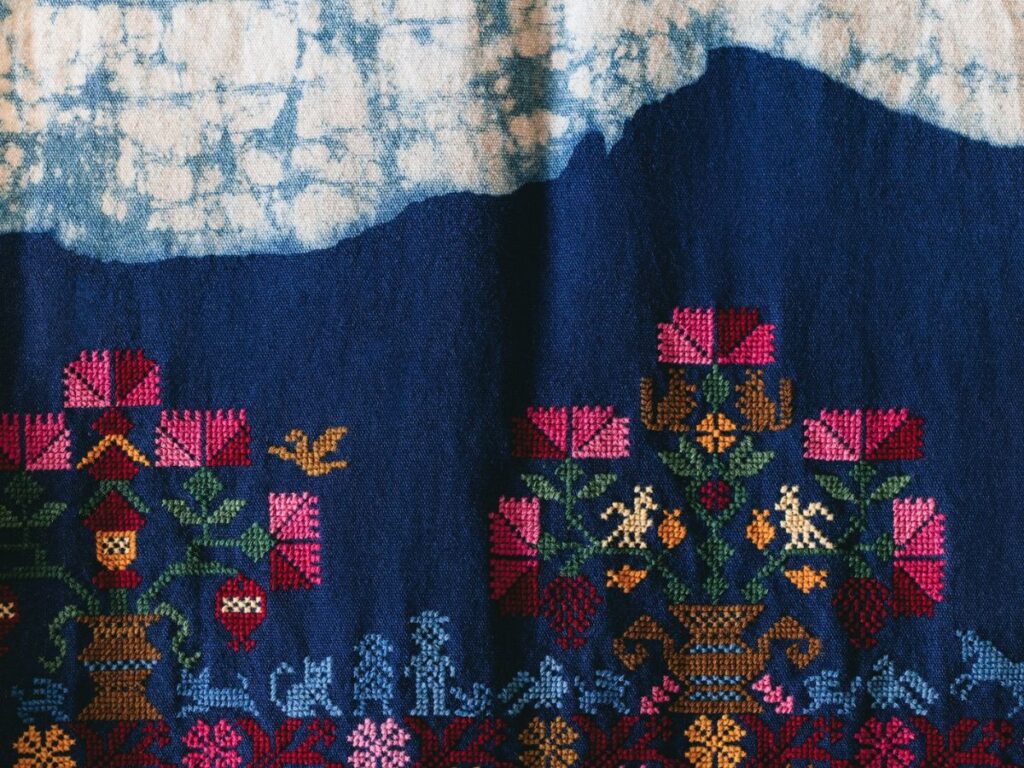
By way of Farid’s practice, these materials undergo a final act of translation. Working with a weaving collective in Nasiriyah, Iraq, she transforms her archive into pictorial tapestries. She was drawn to carpet weaving in the Arab world, positing it as a sort of idiomatic equivalent to western traditions of landscape painting, a medium historically bound to territory. In this way, her tapestries can be thought to memorialise and territorialise “elsewhere”, the imaginary of the homeland and the place from which one yearns for it, constructed in its image.

Farid currently describes her practice as an attempt to “collapse geographies”. Obviously, physical distance is no match for Farid, whose primary studios are two connecting flights away from each other, but this language is directed at structures of power and the ways they border and divide communities. A commitment to resisting them is a lifetime of work, but perhaps precisely because they are so pernicious, this work can take place anywhere.

Cover image: Kuwaiti-Puerto Rican artist Alia Farid on woven carpets at the Friday Market, Kuwait
READ MORE

Sheikha Al-Mayassa remembers the Father Emir's belief in people, education and culture, and welcomes readers to a new season in Doha
As Qatar Museums celebrates 20 years, we explore 20 ideas that have transformed the country’s cultural landscape
An exhibition at the National Museum of Qatar showcases ancient Chinese ceramics from across the Maritime Silk Road
With his first retrospective at M7 in Doha, Erdem Moralioglu looks back on 20 years of sartorial inspiration
Artist Sophia Al-Maria traces the human impulse to leave a mark, from the walls of her grandmother’s home to ancient Egypt
Mapping the 61st Venice Art Biennale in numbers – attendance figures, debut nations and the Qatar Pavilion
Sheikha al-Mayassa in discussion with Luis Monreal, general manager of the Aga Khan Trust for Culture
A playful sculpture by Shezad Dawood in Doha’s Al Masrah Park
Design Doha artistic director Glenn Adamson on the power of design
Giuseppe Penone’s first major solo show in the Arab world brings six decades of work to Qatar
Fahad Al Obaidly, director of the Design Doha Biennial, asks what it takes to build a lasting culture of design
Gerhard Richter brings art and architecture together in a new permanent pavilion in Doha
Exquisite jewellery from Qatar Museums’ collections is paired to explore the art of adornment from around the world
Qatar’s pavilion at the Venice Biennale marks the growing influence of Arab states in the international art world
Design Doha’s flagship exhibition, Arab Design Now, celebrates a new generation of designers redefining the region
An exhibition at M7 looks at a new wave of contemporary Mexican artisans reinventing ancestral crafts
Nada Shabout on the legacy of the Baghdad Modern Art Group
Fashion designer Samah Sulyman reflects on her experience at Fashion Art Toronto
Doha-based fashion entrepreneur Roni Helou shares his favourite places in Qatar
Tracing more than a century of history at Jean Nouvel’s National Museum of Qatar
A design collective uses weaving to create a participatory installation that explores tradition and shared histories
Wassan Al-Khudhairi, the artistic director of Art Basel Qatar 2027, reflects on the creative ecosystem she helped to shape
Qatari collector AbdulRahman Al Khelaifi reflects on building the region’s largest collection of African art
The co-founder of Doha-based Boo Design Studio shares the inspiration behind the studio’s work
Highlights from the programme of exhibitions, installations and events taking place across the city during Design Doha
Mexican designer Fernando Laposse explores the future of farming through a new body of work for the Design Doha Biennial
The Aslan’s Love exhibition by Turquoise Mountain explores Palestinian craft, from glassblowing to embroidery
Fusing the geometry of Islamic architecture with motifs of Bedouin weaving to create a shimmering installation
An interactive artwork seeks to create a sense of community through the evocation of nature and traditional crafts

Issue 000 Contents

FEATURES
NEWS

Contents

Features

NEWS