- Design
- Autumn/Winter 2026-27
- OCTOBER
Patterns
repeating
Designer Ghadeer Mohammad fuses the geometry of Islamic architecture with motifs of Bedouin weaving to create a shimmering installation, curated by Sahar Almuscati
Words Rawaa Talass
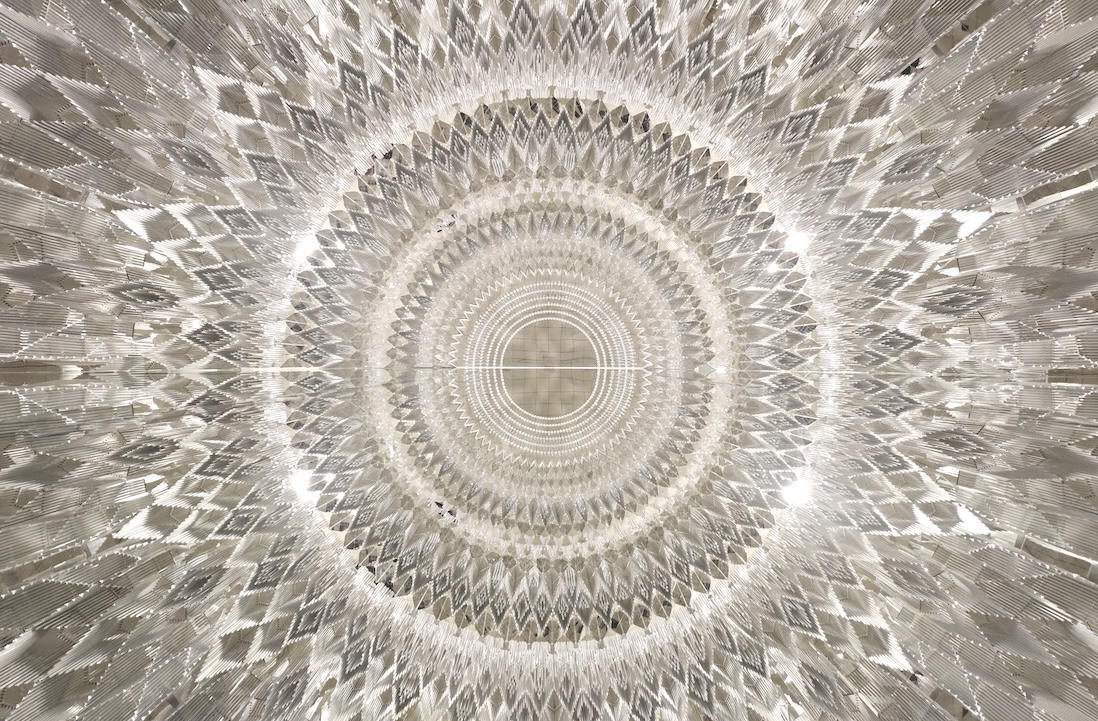
When first encountered, The Muqarnas of Sadu, an installation by Kuwaiti designer Ghadeer Mohammad, reads as architecture, with thousands of luminous metallic elements suspended overhead in what appears to be a huge dome. Step beneath the structure, however, and what is a familiar motif of Islamic architecture begins to unravel into something unexpected, inspired by traditional Al Sadu weaving.
“I wanted to prove that different art forms can be combined, no matter where they come from,” explains Mohammad. The Muqarnas of Sadu does just that: merging the form of muqarnas, a decorative technique found in historic Islamic buildings sometimes called “stalactite vaulting”, with the visual language of Sadu, a traditional Bedouin craft that has long been practised across the Arabian Peninsula.
In bringing together these two practices – soft and hard, flexible and structural, dynamic and static – using digital modelling, Mohammad blurs temporal, geographic and disciplinary boundaries. What emerges is a vision of heritage that is ever evolving and continually surprising.
The artwork – which is supported by Al Sadu Society, a non-profit group that preserves and promotes Kuwaiti Bedouin weaving – takes the form of a soaring ceiling made of more than 10,000 aluminium elements, arranged in geometric patterns: T-shapes to create the structure, pipes to fill in the form. Light filters through the sculpture, initially distracting viewers from discovering that it is, in fact, a half dome and not a full one.
Mohammad, who is studying for a master’s degree in architecture at Kuwait University, explains that spatial constraints at the site where she first developed the idea – Sadu House, a Kuwait City museum that preserves and showcases this textile tradition – forced a choice: either scale the project down or split her intended dome in half.
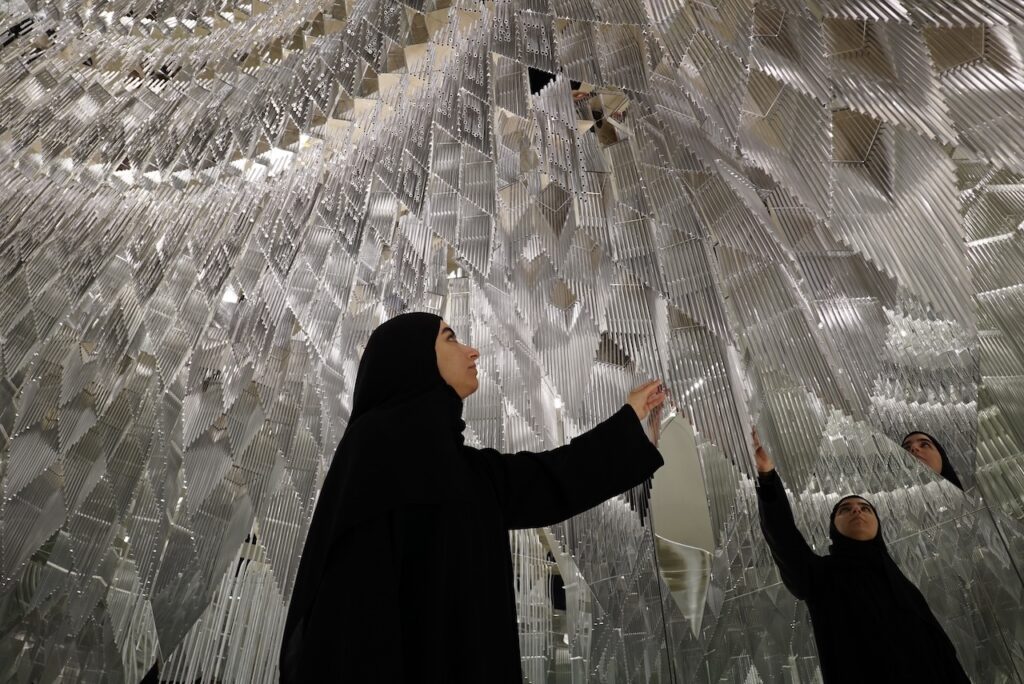
Unwilling to compromise on the sense of awe she wanted to evoke, Mohammad opted for the latter, using a mirrored wall to create the illusion of a complete rotunda. “We made sure we glued the pieces straight onto the mirror so it would be hard to see the dividing line,” she says. To encourage physical engagement, the lowest layer of the structure is within touching distance.
Sadu weaving is a rural Bedouin craft that has traditionally been used to make both decorative and practical items, including tents, bags, furnishings and sometimes clothing. It features figurative and symbolic elements in the design that evoke the nomadic lifestyle of the people who practise it. In developing the project, Mohammad spent time with Sadu makers, learning about both the technique and the meanings embedded in the patterns.
“They tend to depict the things they see in the desert – tent furniture, jewellery, animals and insects,” she explains. “Each weaver has their own interpretation of these elements, so the same object can look completely different when two people are illustrating it. What’s also interesting is that they don’t start with a preparatory sketch – they just begin weaving and go with the flow.”
“I wanted to prove that different art forms can be combined, no matter where they come from”
Ghadeer Mohammad
From these motifs, Mohammad selected patterns that could readily be translated into three dimensions, and then used the parametric modelling software Grasshopper to explore different configurations. The digital process also introduced a level of efficiency and control. “I was easily able to extract precise dimensions to send to my fabricators, and test how costs would change if I adjusted different elements,” she says.
After a series of materials tests, she ultimately chose aluminium for the muqarnas. The metal deliberately contrasts with the softness usually associated with Sadu weaving, which is normally done using camel or goat hair that has been coloured using plant dyes. Rendered in metal, the patterns are sharply legible against the lighting above.
For Mohammad, The Muqarnas of Sadu is just the beginning. “I want to experiment with how muqarnas could be combined with jewellery, product design or furniture, as well as architectural elements such as walls or columns,” she says. “The possibilities are endless.”
The Design Doha Biennial 2026 runs from 5 November 2026–31 January 2027