- Art
- Autumn/Winter 2026-27
- October
By Sophia Al-Maria
“…With children – you don’t teach them drawing, they paint naturally. We paint naturally, like we speak... That’s how it is. You make a mark, and the mark creates a situation, and this situation calls for other gestures. And it comes along, and you learn as you go”
Etel Adnan, The Paris Review, 2023
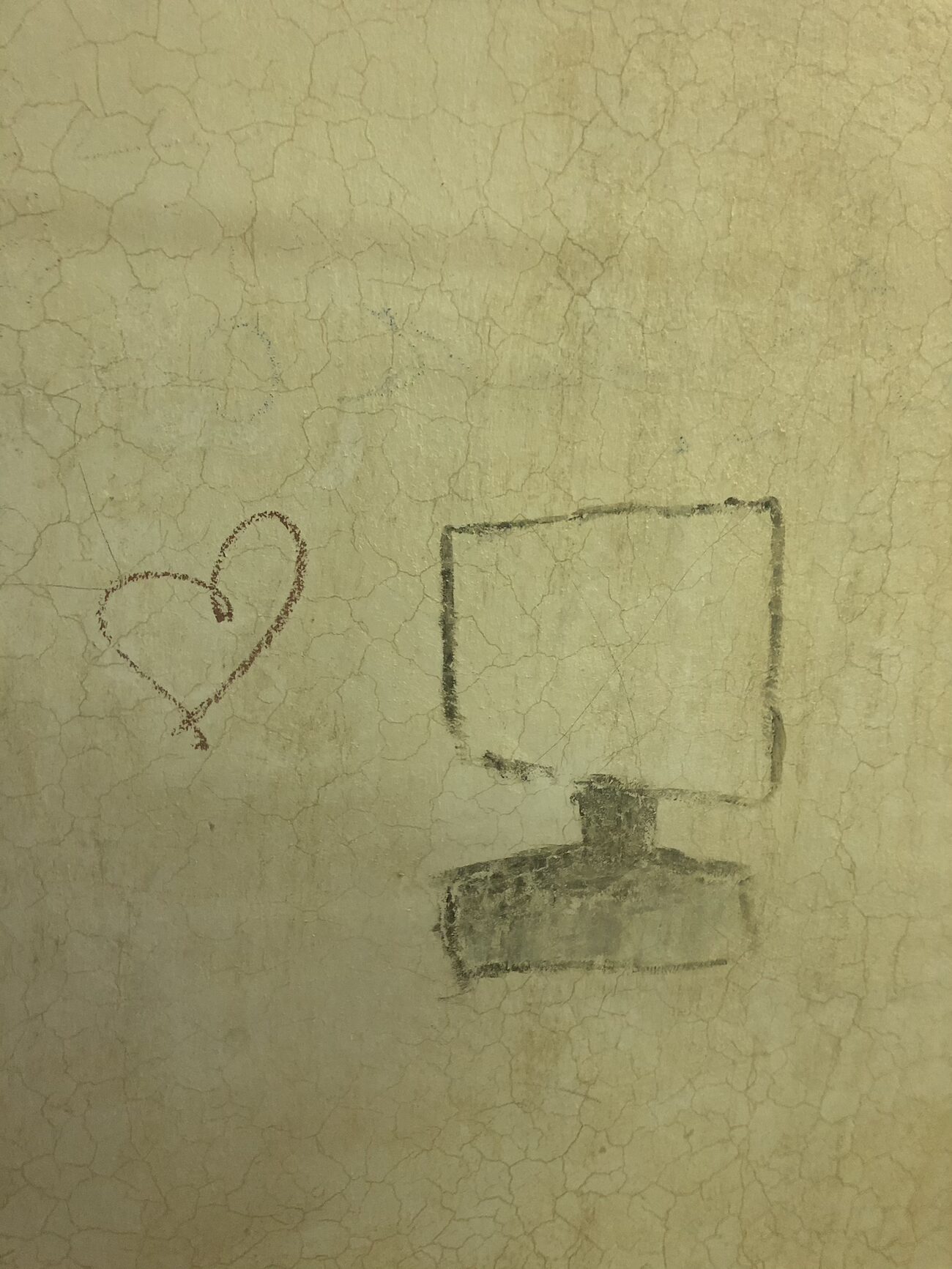
Untitled, c2019-21, artist unknown
This is the single greatest work of art I have ever seen.
But nobody will admit to making it.
I encountered this piece on the wall of my grandmother's house in Doha.
Writing on the wall has become something of a family tradition in this house. When I ask who drew this, my aunts laugh at the question. As if anyone would admit to making it! And anyway, they point out, the writing on the wall is all my fault. I started it. Which, to be fair, is true.
Every generation denies responsibility for their trespasses until said trespasses become socially acceptable. Then, every generation has their share of individuals trying to take the credit for or capitalise upon the previously taboo activity.
I can tell you right now: I am not the genius behind this particular masterpiece. Nor am I the genius in this family or tribe. We have a lot of them. However, by dint of birth date, language and access to education, I am the one writing this for you. I hope you’ll stay with me as we go on this journey which, I promise, will get weird, sometimes awkward. But by the end, I hope you will have learned some interesting facts about our shared history and maybe even have space to reflect on being human. Which I assume you are but I don’t want to make any assumptions. Who knows these days? Perhaps that statement is offensive to an AI agent…
Let’s go back to the beginning: this is a great work of art. Emblematic, even, of a fundamental experience relating to the human condition in the 21st century. The picture is almost aggressively simple: a rectangle – presumably a TV, or possibly a computer screen – and beside it: a love heart. No colour, no shading, no ambition beyond the two shapes and a particular satisfaction to the wideness of the heart and the darkness of the screen’s frame and stand that suggest an aesthetic prodigy.
I know it was drawn by someone about three-and-a-half feet tall and this person was that height sometime between 2019 and 2021, while I was out of the country and therefore unable to be sure. To be fair, I am grateful I wasn’t there. Because would such a great work have been completed under the eye of an authority? I think not. In fact, I’m not sure I could make any work at all if I cared about being watched. The trouble is, like a kid pulling off an amazing trick and then asking for someone to watch, the gaze does tend to scramble the creative act.
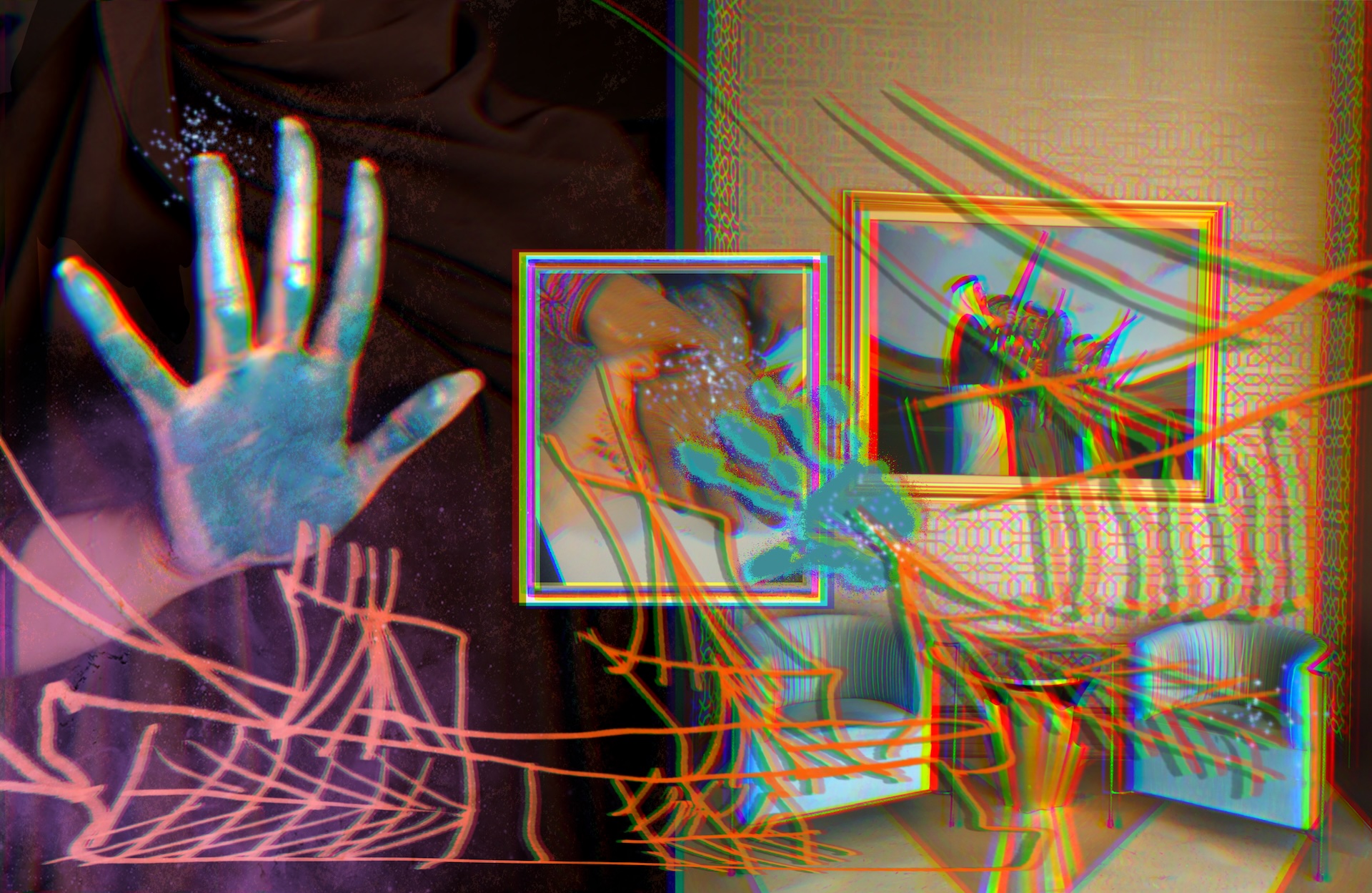
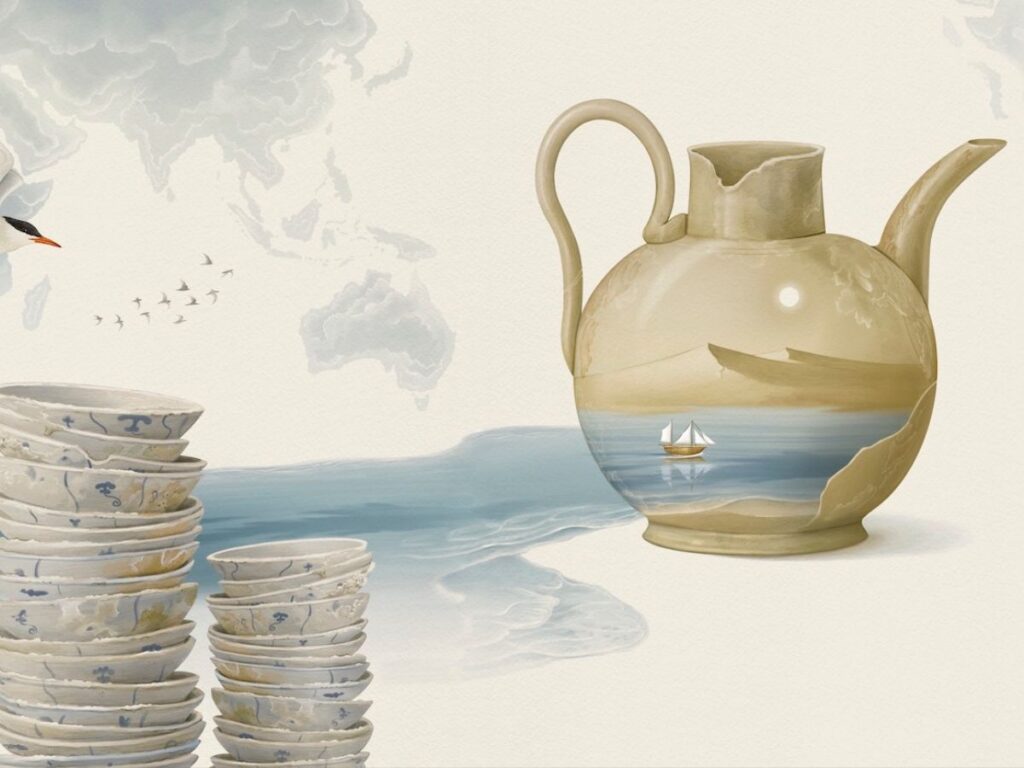
Untitled, 2026, by Sophia Al-Maria, commissioned by Q+A. Photo: Courtesy Qatar Museums
Anyway, in that window of time, roughly 30 children of the correct height passed through that house. It could be any of them. It will never be confirmed. This is, I’ve decided, the correct way for a masterpiece to arrive. Mysteriously.
I have stood in front of paintings worth eight figures that said less than this. A machine beside a heart. That’s it. That’s the whole show, and it’s a complete summary of the human condition circa now. Nobody has signed it and I’m not going to be the one who starts an investigation. I got in enough trouble for uncommissioned wall art in this exact house to know how that goes.
I got my first cell phone in 1999. Not a smart one. It was an Alcatel, and it did one thing: let me discuss teenage catastrophes with the operatic seriousness they deserved. This required two things: privacy and reception. In our house, there was exactly one place with both – the top of the stairs to the roof. So, every afternoon, I’d climb up, dissect some crisis that wouldn’t survive the week, and doodle on the wall with whatever pen was in reach.
Privacy in a house full of unsupervised and curious children is impossible. My little brother and a rotating cast of cousins would materialise, feign disinterest and sit down a few steps down from me to colour and eavesdrop. My little brother would draw the tricked-out 4x4s the guys he looked up to drove, with super long antennas that appeared to be reaching for satellites. Eventually an adult noticed the drawings on the wall. I took the fall, being the eldest of what is now roughly 60 cousins, and therefore the one who set the example.
I grew up. I left Doha. I assumed someone would eventually paint over the stairwell. Nobody did. In 2022, I discovered the drawings had not only survived but expanded, spilling down the staircase, colonising the landing, surrounding the kitchen doors, claiming every threshold and blank corner within reach. Several generations of children had independently arrived at the same conclusion: a blank wall is an invitation. Because look! Astonishing! I am so proud!
Somewhere in that accumulated archive of names, jokes and trucks, somebody drew a screen with a heart next to it which is, tbh, as good a way as any to get from a house in modern-day Doha to a centuries-old ruin of a town a 40-minute drive up the peninsula.
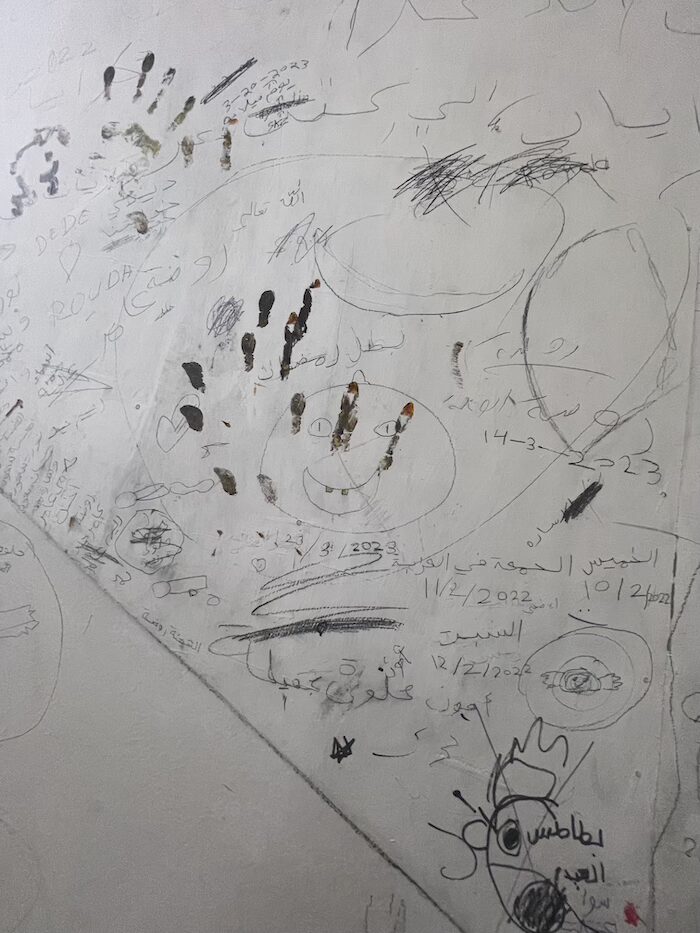
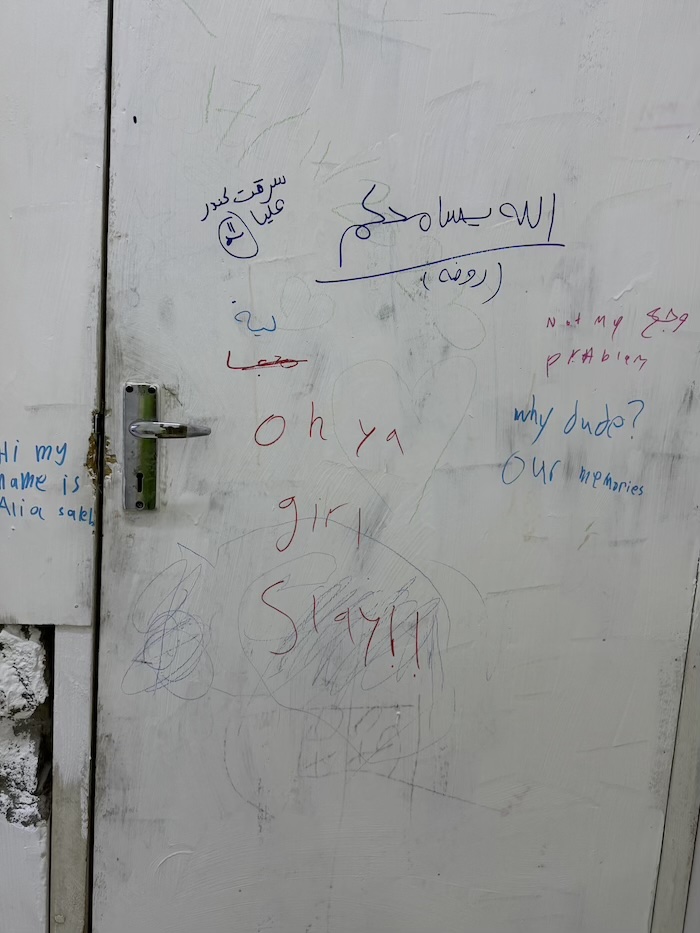
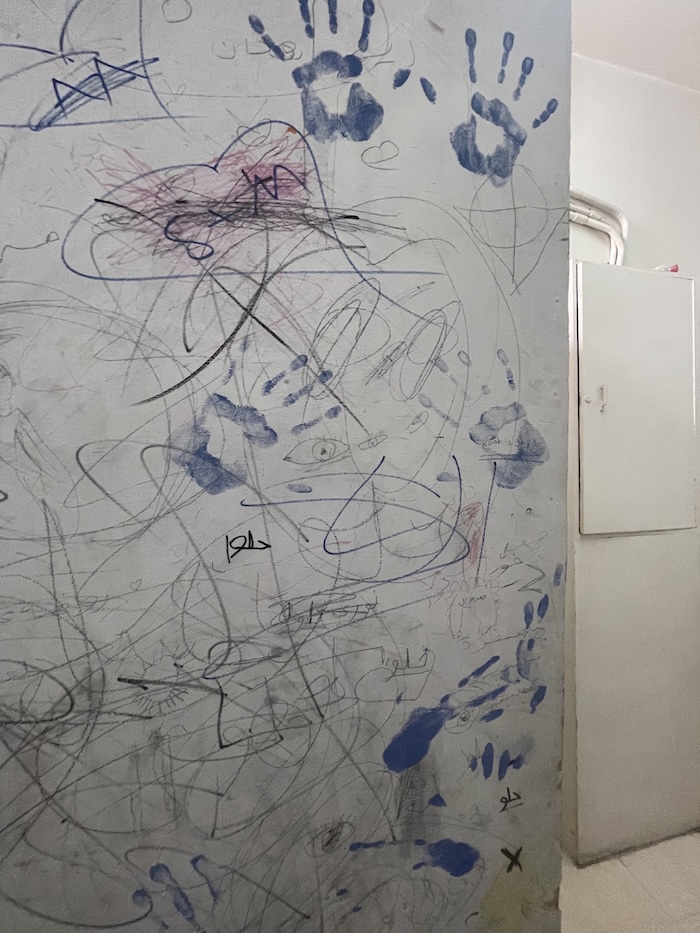
Drawings and writing on the wall at Sophia Al-Maria’s grandmother’s home in Qatar. Photo: Sophia Al-Maria
PIC OR IT DIDN’T HAPPEN
The history of anonymous art is, unsurprisingly, full of anonymous artists, writers, witnesses. Qatar has its share. There was the janitor who drew fantastic beasts on the walls of the country’s first boys’ school. An established artist who went to that school claims to have other examples of his work and to know more about the artist and the man, but won’t share unless he is paid. Gatekeeping is one of my least favourite traits in a person.
Then there is, most likely, the young cousin of mine who is a genius. And now, I’d like to draw your attention to somebody in Al Zubarah, in the winter of 1671.
Al Zubarah was a tiny pearl-diving village on the trade route between India and everywhere else. We’re going back to more than 250 years before it got a fort in 1938 and became a major coastal trading town, and before that fort became a ruin, and that ruin became an archaeological site, and that site became a Unesco World Heritage Site you can visit on a Friday.
Picture a bored 11-year-old. A Gemini, obviously – hence the talking, which will be important to this story. Her father is a pearl diver, or possibly a pirate; nobody will confirm which, so she’s invented several versions, all of them heroic, most of them false. Her mother, exhausted from raising everyone else’s children as well as her own, has stopped listening to her and started sending her outside each morning to watch the horizon for her father’s pirate ship or pearling vessel.
She sits by a collapsed mud hut and waits. Sailors understand the sea’s rhythms, tides, seasons and migrations. To a child stuck on land, it just looks like nothing happens, ever, on a loop. Yes, children in the 17th century also got bored.
Then, one day, something happens.
There’s a particular circuit in the human brain that fires when something shows up that you can’t explain. We all have our UFOs. Ours come with a camera phone ready to capture them; the little Gemini’s didn’t. What she saw instead of a dhow, instead of anything from India, was a ship unlike any she’d ever heard of. It looked like it had sailed out of one of her own invented stories.
“What IS that?!” The words are out before she’s had a single second to organise them, announced to the air.
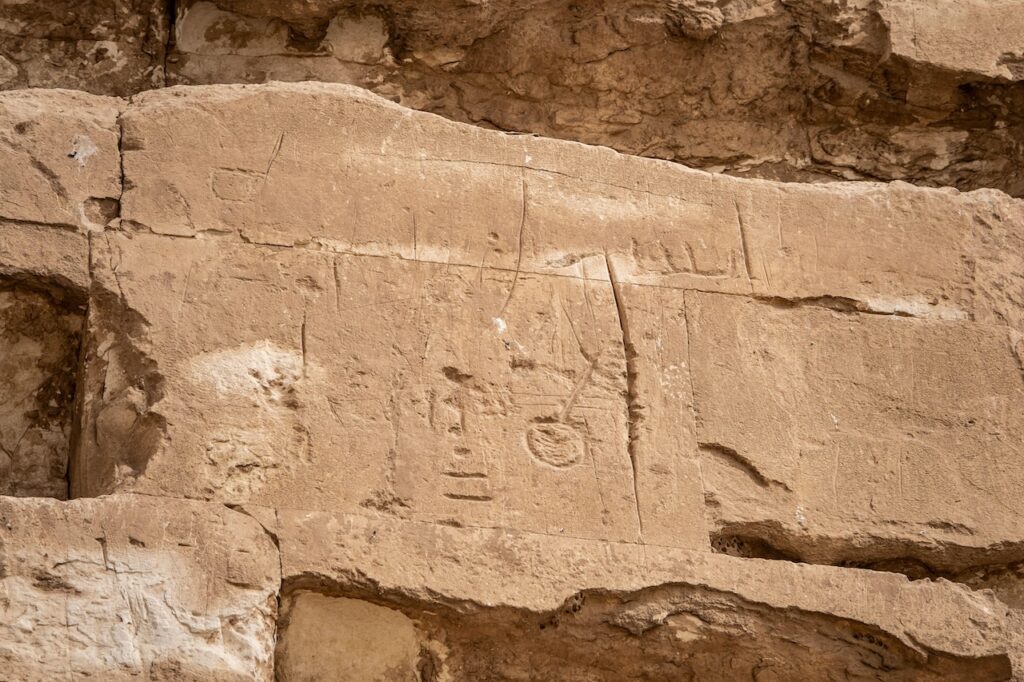
This is also the same kid who, months earlier, cried wolf about an actual Arabian wolf – which once roamed wild across the peninsula – and was ignored for it. Nobody will believe her this time either. So instead of running to tell anyone, she grabs a stone and starts recording: how many oars, how many sails, how many boats. She etches the whole fleet into the wall, in the oldest form of “I have proof”.
It reads, all these years later, like a conspiracy theory; one little person’s testimony against a world that had already stopped listening. Archaeologists eventually identified the vessel from her scratches alone.
It was a European galleon.
The wolves, as it turns out, were real.
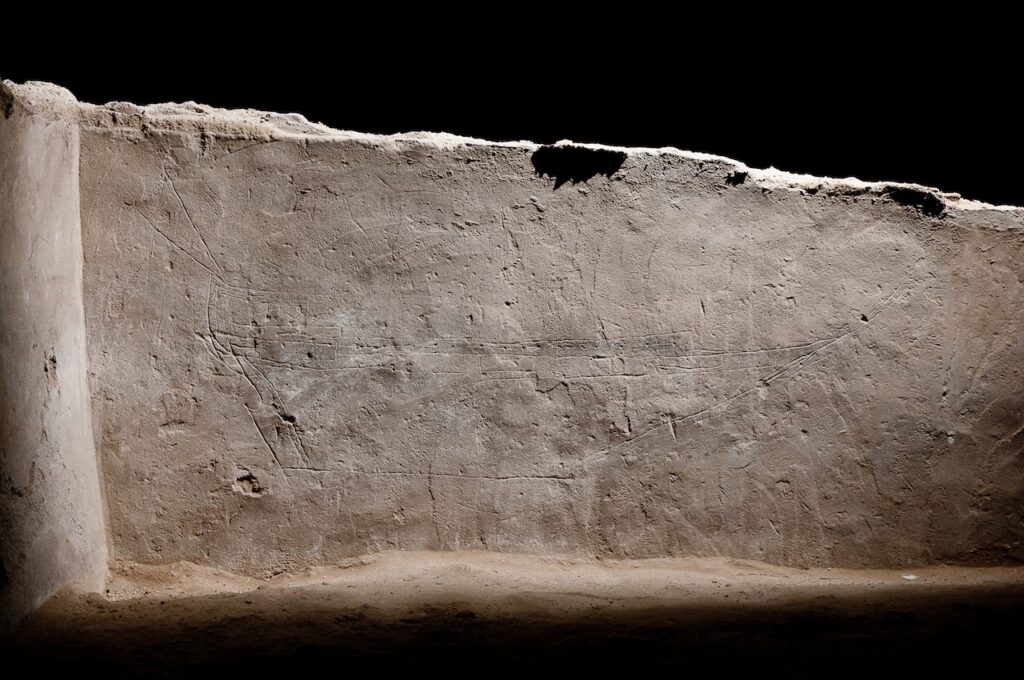
“The history of anonymous art is, unsurprisingly, full of anonymous artists, writers, witnesses”
POMPEII, OR THE WORLD’S OLDEST COMMENTS SECTION
Pompeii is remembered for the way it ended. Vesuvius, the ash, the tragedy. Before that, like any city, it was mostly full of people being annoying to each other on purpose.
I spent time there last year with the contemporary art programme “Pompeii Commitment. Archaeological Matters”, and what stopped me cold wasn’t the frescoes or the casts of bodies in heartbreaking poses of expiry… it was the graffiti. Politics, bad breakups, brilliant insults. Someone mocked a rival for being terrible at sports. Someone wished spectacular haemorrhoids upon an enemy, in writing, for posterity. Layered underneath, the mundane hum of a city talking to itself: “I made bread.” Answered, days later, by someone furious: “Stop using this wall as a toilet!” It’s a comment thread that ran for years.
One line, unattributed, has outlived its author by two millennia: “O walls, you have held up so much tedious scribbling that I am amazed that you have not already collapsed in ruin.”
Snap!
This evokes the exact sensation of overhearing an absolute takedown of a comeback, or scrolling some of the more erudite /’s of Reddit. The tools have changed. The feelings have not.
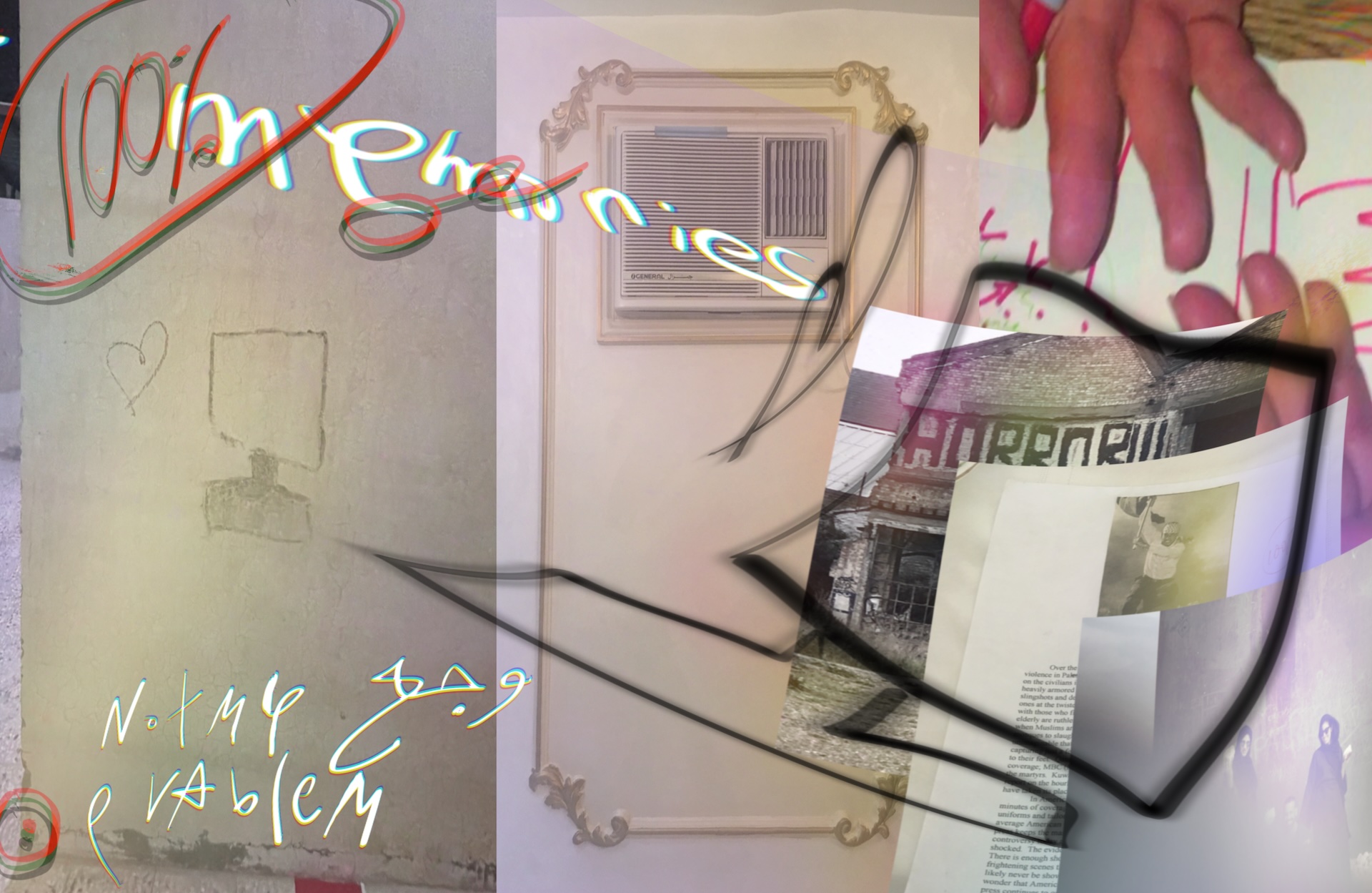
Untitled, 2026, by Sophia Al-Maria, commissioned by Q+A. Photo: Sophia Al-Maria
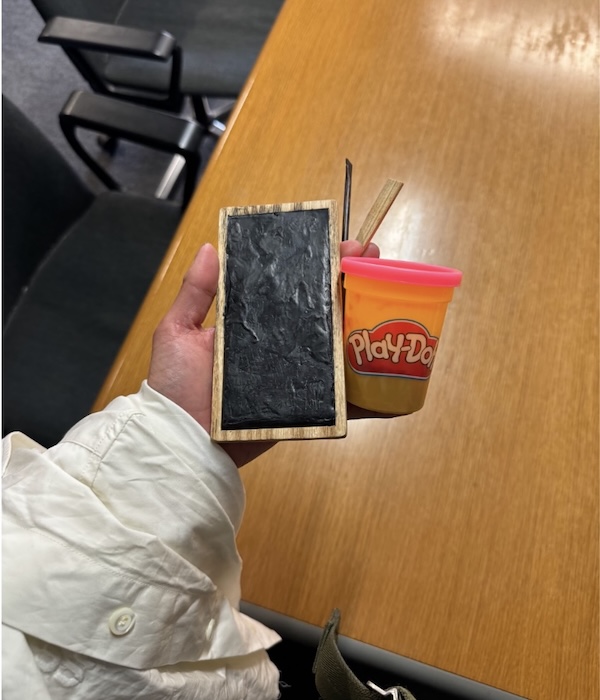
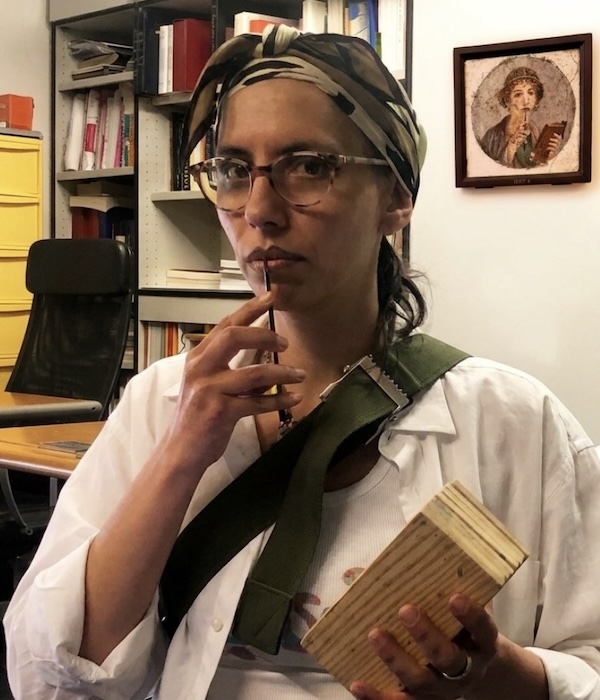
After Pompeii, I went to a university in Naples to meet an archaeologist who specialises in graffiti. He handed me a working replica of a wax tablet, the ancient equivalent of our own tablets. Flat, stylus tied to the side, it felt unnervingly familiar. As did the smell of the fluorescent pink Play-Doh he gave me to practice my cuneiform.
I asked how much “X wuz here” graffiti he had found and wondered whether Romans picked their wax colours the way we pick phone cases. Whether there was a fresh tablet for the new school year, etc. It was, either way, the first device that let you change your mind: write, erase, smooth it over, begin again. We take that for granted now. They had to earn it with heat and a flat edge.
Wax resists curves, so Roman handwriting evolved to be quick and angular – the tool shaped the hand as it were. The archaeologist warmed the wax, scratched a note and handed it over: “R U here?”
I laughed. He said, “Come on, write something.” I wrote back the only thing that felt honest: “IDK”.
He made me take the tablet home. On the flight, it sat in my purse next to my phone – the same size, similar function, yet 2,000 years apart. Underneath his careful Latin, I added my own inscription, in Arabic:
ههه
ALL TAGS ARE GEOTAGS
Now let’s get back into the improbability machine and keep time travelling, as we have a rendezvous with a group of tourists from southern India who want to visit the Valley of the Kings in Egypt in the year 157CE.
What makes this group of travellers so special? Well, nothing. Except they did what travellers have always done at a famous site: they left proof they’d been there. We know because “came and saw” is scrawled across the tomb walls in Tamil-Brahmi script; the ancient equivalent of a geotag and touchingly modest as tagging goes.
Not everyone in the group shared that restraint.
A traveller from India named Cikai Korran was undeterred by the Eye of Horus, or by 4,000 years of accumulated sanctity. And yet the part that derails me completely is how undeterred by height he was. This Cikai Korran guy carved his name into the Valley of the Kings not once, not twice, but EIGHT times! Each attempt was more vertically ambitious than the last, culminating in an inscription four metres above a tomb entrance that required, as far as anyone can determine, an elephant used as a footstool.
We’ve all heard the modern version of this story: the tourist who carves initials into a temple and becomes an international incident. Cikai Korran suggests the impulse is not a symptom of the smartphone era. It is simply the human condition.
Let’s pretend Korran was a businessman who made his fortune selling asafoetida to the Roman Empire (they loved using asafoetida to spice dormice in Rome). Now imagine him, legs spread, fists on hips in a commanding pose casting a long shadow across walls painted with scenes of the Egyptian afterlife. He turns to his retinue and announces, with the confidence of a man who has never once doubted himself, “You know what this place needs? A sign.”
“I wondered whether Romans picked their wax colours the way we pick phone cases”
Nobody argues. He is, after all, the one paying everybody.
He summons his two most trusted men. Let’s call the first one Sāttan (a name as common in that era as John or Ahmed) and Nambi (which roughly translates to “trusty” – a job description doubling as a name). “Nambi. Up on Sāttan’s shoulders. Take the knife,” Korran might have said. “Write what I tell you!”
Korran is already composing the line in his head: “Cikai. Korran’s. Famous. Asafoetida. Available. Now.”
The first attempt goes fine. The second attempt does not.
“No. Higher!”
“Cikai, we can’t reach any higher.”
“Where is Kiki? Bring me Kiki!”
Sāttan and Nambi run out the door.
Kiki, a prodigiously sized elephant is summoned and squeezed through the door. She raises one foot up as a step and Nambi climbs onto her head and carves the name above Ramesses IV’s tomb, hops down, dusts himself off. “Happy?”
Korran studies the inscription four metres overhead and delivers the verdict of every difficult client in the history of advertising: “Well, now that’s too high. Who’s going to see it up there?”
Nambi and Sāttan exchange the silent groan of two employees who have had this conversation before. Kiki lumbers out, annoyed. Whether the group made it on to Rome, or gave up and sold the asafoetida at a discount somewhere along the way, history does not record. What survives is the sign. Which, if you think about it, was the entire point.
THE SECOND-GREATEST ARTWORK OF THE 21ST CENTURY
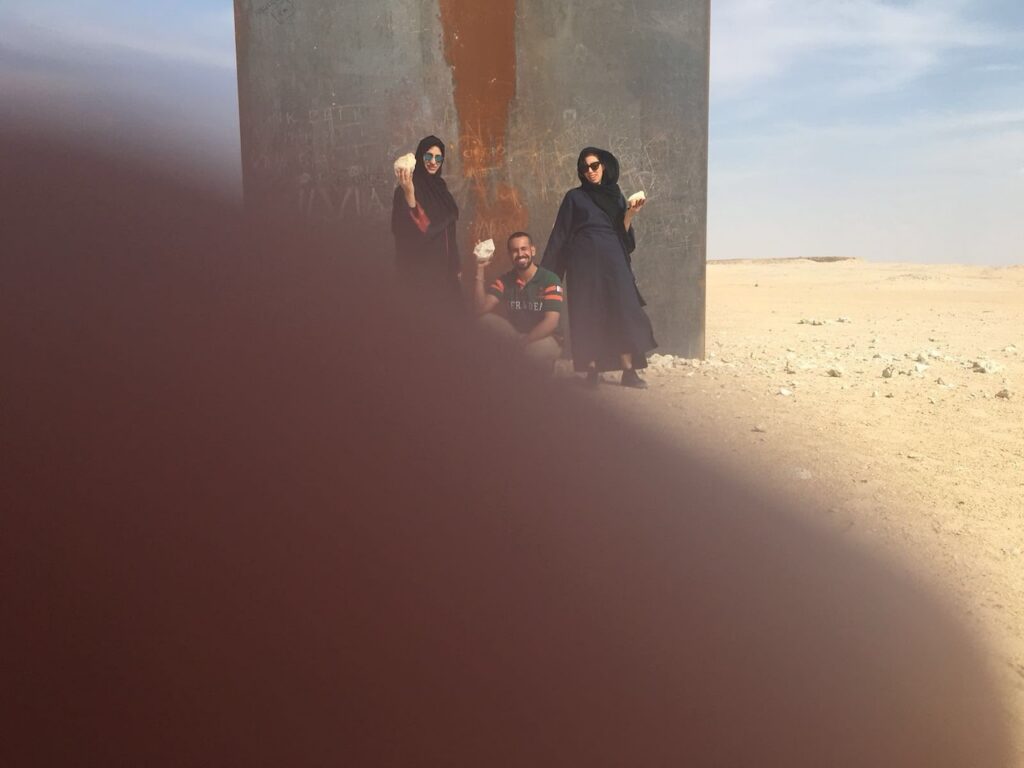
My father just sent me these old pictures he once took of myself and two friends. Yes, that is his finger obscuring the camera lens. It was around a decade ago, I was giving a tour of Qatar to two friends from Kuwait and Saudi who’d never visited before. We drove out of Doha in my low-riding rental. We were heading towards the Cuban Hospital, where my father worked as a human resources manager and, more importantly, had his 4WD parked. We met him and then drove off-road into the Brouq Nature Reserve in Zekreet to see Richard Serra’s East-West/West-East.
I will say this plainly and without the sheepishness that identity politics might encourage when saying such a thing of an old-white-American man’s work: this is the greatest work of art I have ever seen (second only to the untitled work on my grandmother’s wall). Hyperbolic maybe, I don’t get carried away often. This is simply my perspective.
East-West/West-East consists of four enormous steel plates, ranging from 14.7 to 16.7 metres tall, running for over a kilometre through the Brouq Nature Reserve. The steel is engineered to weather from grey to orange to Serra’s preferred patina of deep, settled brown. What Serra didn’t fully plan for was the public, who arrived almost immediately with a different idea of what “weathering” could mean, and started applying what I can only describe as a “human patina”. Qatar Museums considers this vandalism and runs active campaigns against it, which is a perfectly reasonable position for an institution responsible for a Serra to hold.
I disagree, anyway.
I’ve only ever seen Serra’s work wedged between high-rises in Western financial districts; unremarkable if you don’t look up from your phone and in-the-way if you’re a commuter about to miss your train. Out here, layered with a thousand names and dates, in a landscape you have to actively choose to get to, it stops looking like blue-chip sculpture and starts looking like a stargate that time travellers (like us) forgot to seal. And, around the threshold of this stargate – names, names, names! “Jake Wuz Here”, “BRAZIL”, “Not my prablam!”
Standing between the plates, the carved names don’t read as damage to me. They read as time, mortality, protest against being forgotten out here in the middle of nowhere. They remind me of giant steel gravestones, or messages aimed at whoever comes next, human or otherwise. A blank surface is still just an invitation, whether it’s a stairwell in Doha or a kilometre of steel in Zekreet.
For me, a work of art only really succeeds once someone can’t resist getting involved. Does it matter if that involvement takes the form of defacing1, restoring2 or, in some cases, erasing3? I think not. For me, the point is the gesture.
And the gesture comes from the same instinct, every time. The Tamil guys carving “came and saw” into the Valley of the Kings. The pirate’s daughter recording evidence of potential invaders. The cranky landlord in Pompeii. A three-and-a-half-foot artist drawing a TV with a heart next to it. Somebody standing in front of 281,000kg of engineered corten steel, deciding the appropriate response is to reach for the nearest chunk of chalky stone and leave a mark.
“For me, a work of art only really succeeds once someone can’t resist getting involved”
SAND IN MY LIPGLOSS
Given enough time, any surface within reach becomes collective.
Out past Serra’s sculpture, the desert is full of these messages, and none of them belong to the names remembered by history. A man named Addān, thousands of years ago, carved his grief that his brother had been taken by a rival tribe. Someone else recorded, with real satisfaction, that they’d bagged an ibex. The Banī Ḥdy left word that their goats had fallen sick and they were frightened for what came next. Others simply asked for rain, because everyone, always, needs rain. We are all wanderers in this vast desert of time after all.
Which brings me back to the beginning. To Lebanese poet Etel Adnan, whose words began this story. In 2020, I asked her to record a voice note reading the following lines for a film I was making. She honoured and blessed me with a recording and it sits as the central pivot of the film Tender Point Ruin4. In it, her voice halts and starts, her words playing over Nasa footage of the surface of the moon.
“The qasida is an ancient Arabic word and form of poetry, the endings diverge but they almost always start the same. With al-atlal – the traces. The poet, a lonely lover, is in pursuit of the lost beloved. They come to an abandoned campsite and directly address the traces they find – in the sand, on a wall, in the remains. These remains conjure memories of what has been abandoned in the ashes of a home fire. We accompany them to the tender point of ruin.”
I’d never been to Granada until last month. I found myself wandering the streets past midnight, ankles looped by hungry alley cats, stopping every few steps to look at the writing on the walls. Granada’s love graffiti is a genre of its own. One suspects the Nasrid sultans, master mark-markers themselves, would approve of these walls being inscribed edge-to-edge with poetry. They would recognise the impulse even if they might wince at the execution.
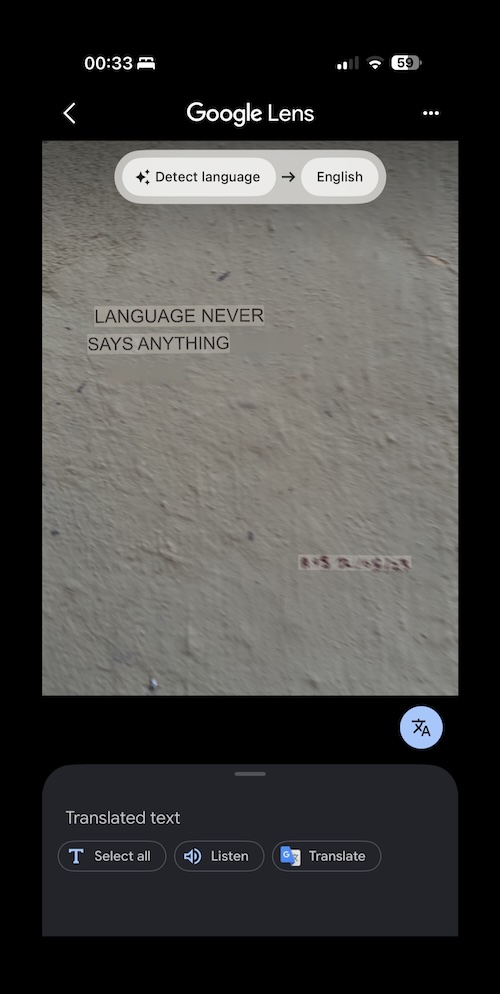
I began photographing the writing on the walls, putting the images through Google Lens to translate. The results are amazing, and strangely intense in the way a teenage girl’s notebook would be. I feel like some kind of linguistic diviner, dowsing for meaning in the girlish, bubbly scrawling in Sharpie and Posca pen that lines every surface. The willingness to announce, in public, often with embarrassing exclamatory bursts – “Your beauty destroys me!” or “I carry your love like a dagger in my chest!” – is on full display across Granada’s walls.
The melodrama.
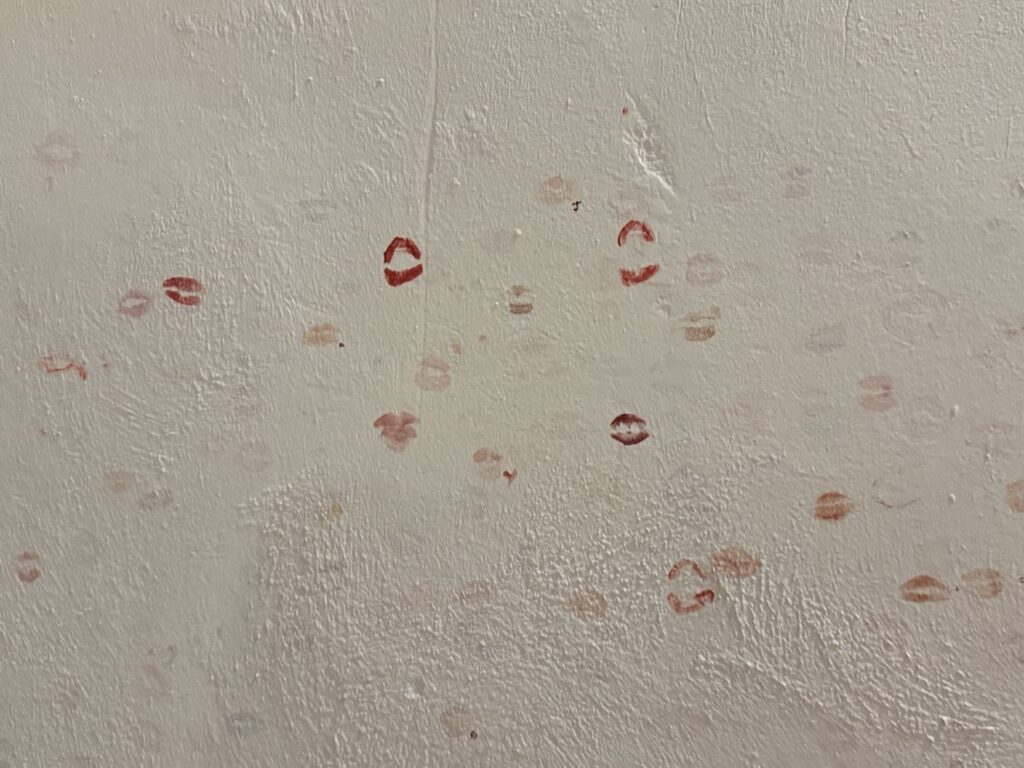
Notably, these walls are also a palimpsest of lipstick traces. Every colour from pastel peach to glittery gloss, the vamps in Ruby Woo red and, here and there, the occasional shy blackberry. How many faces leaned forward to sign the wall with puckered lips? Have I ever seen this anywhere other than a girl’s bathroom in a public school where the janitorial staff are on strike? I mean, I knew Granada had a mythology of romance, a longing for a vanished world, the Islamic golden age and all, but who knew it was such a pilgrimage for anyone overwhelmed with such big femme energy.
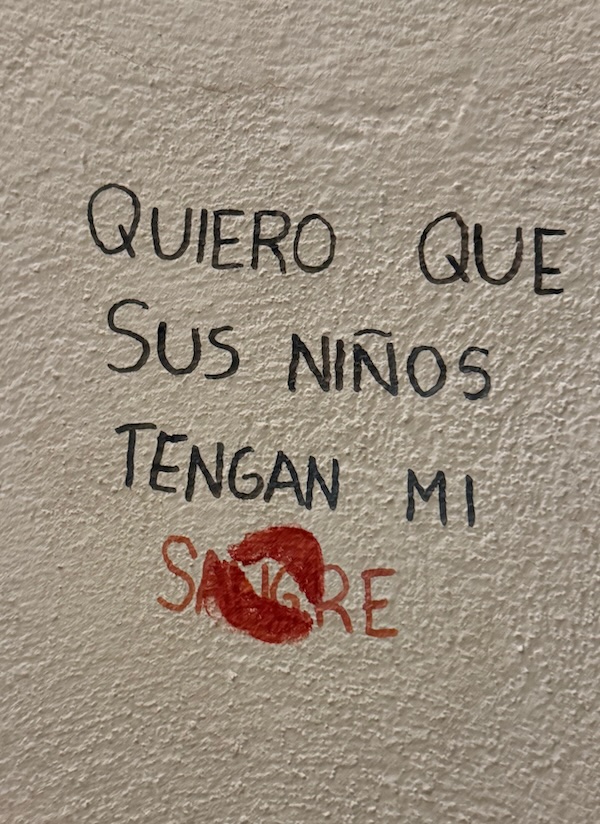
The writing and lipstick marks on the walls of Granada in Spain. Photo: Sophia Al-Maria
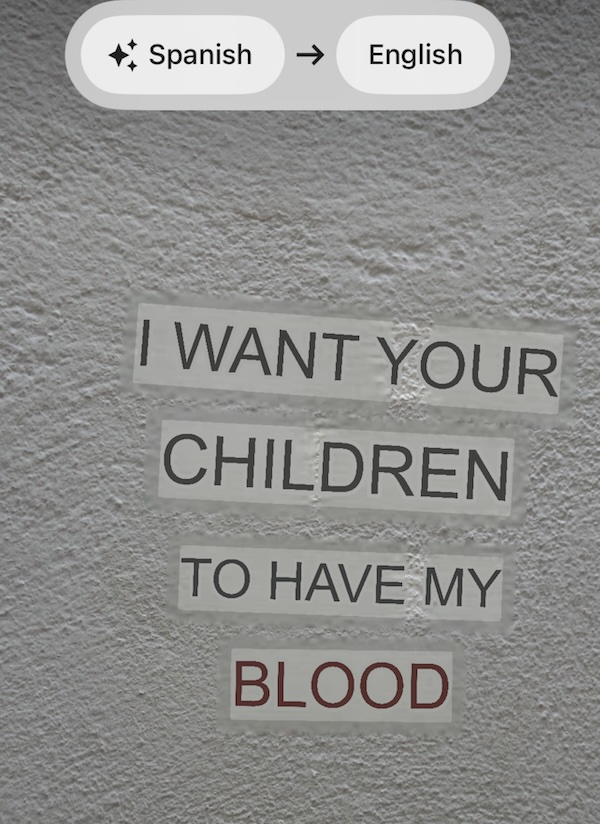
The writer’s translations using Google Lens. Photo: Sophia Al-Maria
I come across this one:
“QUIERO QUE SUS NIŇOS TENGAN MI SANGRE”
And translate it:
“I WANT YOUR CHILDREN TO HAVE MY BLOOD”
Woah. Intense.
I make an editorial mark, applying my red lipstick over the word “BLOOD”.
“I WANT YOUR CHILDREN TO HAVE MY FOREHEAD KISS/LOVE”
Better.
I have made my mark.
The mark makes me visible.
The mark changes the surface.
Will someone see the mark?
Will the mark outlive my presence?
This all-day, long-wearing lipstick is so pigmented, I might just
time-travel back to the Neolithic wet period when someone
in Tassili n’Ajjer saw a UFO and decided to paint it. They would
love this orangey-red.
It is called “Reunion”.
Anyway, I suspect my kiss will outlive me.
I hope it will not need translation.
Will they wonder who I was?
Probably not.
To go back to the question in the wax tablet replica, “am I here?”
For now. Yes.
Will anyone remember my name?
Will anything of me remain?
No.
But perhaps, if I’m lucky, traces of my humanity will.
x
Notes
1. Diego Velázquez’s 1651 masterpiece, The Toilet of Venus (aka The Rokeby Venus), ran afoul of a good cause when women’s suffragist Mary Richardson walked into London’s National Gallery and took a meat cleaver to the Goddess of Love’s behind in protest at the arrest of a fellow suffragette.
2. The 2019-20 restoration of the Adoration of the Mystic Lamb panel from the 15th-century Ghent Altarpiece revealed that the central Lamb of God originally possessed an intense, forward-facing and “alarmingly humanoid” face that had been covered by 16th-century overpaint.
3. In 1953, young artist Robert Rauschenberg asked celebrated master Willem de Kooning for a drawing to completely rub out. De Kooning reluctantly agreed and handed over a dense work made with oil, charcoal and pencil. Rauschenberg spent a month erasing it, creating a new conceptual piece about absence, creation and destruction.
4. Tender Point Ruin, 2021, is the second part of a lo-fi sci-fi film trilogy by Sophia Al-Maria that also includes Beast Type Song, 2019, and Tiger Strike Red, 2022.