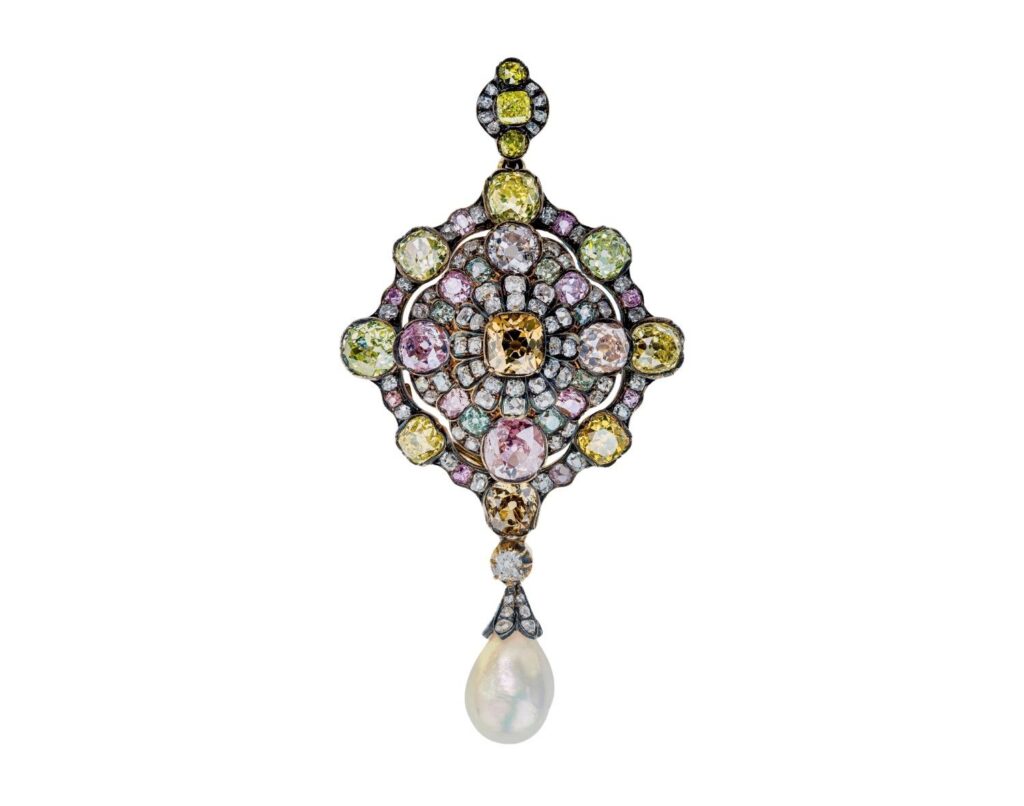
Fancy-Coloured Diamond and Pearl Brooch
The ornate late 19th-century brooch brings a remarkable spectrum of coloured diamonds together to create a work that is a highlight of Qatar Museums’ National Collection of Qatar. At its centre, a domed roundel and rosette are pavé set with fancy diamonds in contrasting hues, sizes and cuts, allowing light to enter and intensify their colour.
Made in London, England, in 1890, this brooch was created during the Belle Époque era, which spanned between 1871 and 1914 and was a time associated with romance, cultural flourishing and rapid scientific and technological change. While Paris was the epicentre of this historical period, English life and culture were influenced by it.
The brooch’s exuberant use of colour is particularly unusual for a period in which the so-called “white style” of jewellery, which employed platinum, pearls and diamonds, was favoured. The brooch’s Renaissance-inspired vertical form places it within a wider revival that ran from the 1850s through to the 1890s, as jewellers in Paris and London looked back to the ornate, devotional jewellery of the 16th-century courts.
Fancy-coloured diamonds of the kind found in this piece have drawn royal collectors across the centuries, from the Mughal emperors of India to Louis XIV, the Marquise de Pompadour and the tsars of Russia.
The unusual hue of the diamonds emerges over billions of years, as the carbon lattice of a forming diamond develops rare structural distortions, sometimes combined with trace elements such as nitrogen or boron. The resulting stones are then graded by saturation and tone, on a scale running from “fancy light” to “fancy dark” and “fancy deep”.
Some of the stones in this piece are cut in the Mughal rose style, a shallow, flat-based form developed by master artisans in India between the 16th and 18th centuries. Rather than maximising brilliance through faceting, these cuts preserved the natural, asymmetrical shape of the rough stone, encouraging the soft interplay of light and shadow over symmetry. In the Mughal courts, gemstones signified more than rarity or beauty – they marked strength and authority. (So vast was the Mughals’ collection of such gems and stones that there are reports of royal family members being ceremonially weighed against jewels, gold and gemstones, with the equivalent value distributed to the poor as an act of goodwill.)
Suspended below the diamonds, a large naturally drop-shaped pearl provides a counterpoint to the brilliance of the diamonds. Its subtle tonal variations echo the shifting colours of the stones above.
- Only one in every 10,000 diamonds has a fancy colour, according to the Gemological Institute of America, making these stones among nature’s rarest treasures.
- Fancy-coloured diamonds were often collected in past centuries by royal figures such as the Mughal emperors in India, Louis XIV, the Marquise de Pompadour in France and the tsars of Russia.
- The colour of the fancy-coloured stones carries symbolic weight: pink diamonds – among the most difficult to find in nature – are linked to love and femininity; green diamonds – which form through natural radiation exposure deep underground – symbolise regrowth; and orange diamonds – such as the one found in the centre of the pendant – are among the rarest and most valuable of all, traditionally associated with courage.
- In Belle Époque jewellery, pearls were symbols of elegance, and their milky lustre was used to balance the brilliance of diamonds.
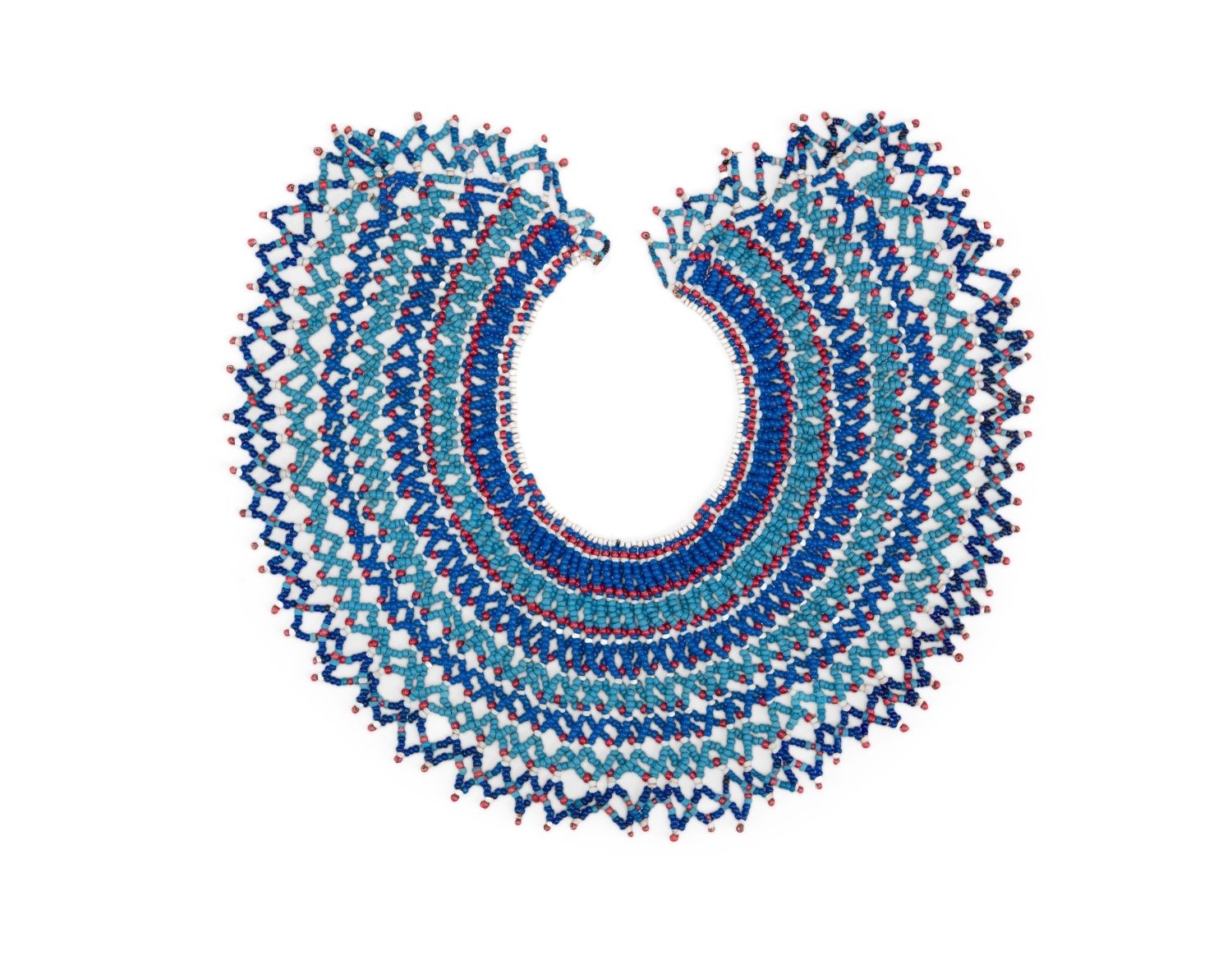
Xhosa Polychrome Bead Necklace
Known as an icangci, this ornate beaded necklace is attributed to the Xhosa, an ethnolinguistic group indigenous to South Africa. This necklace would traditionally have been worn by a married woman, however similar broad beadwork collars – known as ingqosha – could also be worn by men.
Pieces such as this are part of a rich tradition in which beadwork (called ubuhlalu) has been used for centuries to communicate status, age and identity across Xhosa society. The pieces are primarily made by women and are passed down through generations, with young girls learning basic plaiting before moving on to more intricate designs and patterns.
Xhosa beadwork also reflects the movement of women between families. On marriage, women traditionally moved to their husband’s home, taking the beadwork techniques and motifs they had learned from mothers and grandmothers with them. Over time, this circulation of skills helped produce variations and hybrid styles, making the intricate beadwork a record of both lineage and exchange.
This particular red, blue and white neckpiece from Qatar Museums’ National Collection of Qatar is 37cm wide and is attributed to the Thembu people, a nation whose royal lineage includes South African statesman Nelson Mandela.
The small glass beads used in Xhosa pieces like this one – often called seed beads – first arrived in the region through successive waves of trade and colonisation: first via Phoenician and Arab traders, then through Portuguese contact from the 16th century and later through British and Dutch settlers. Many of the beads were manufactured in Venice specifically to be used as barter goods.
The colours in the beadwork are symbolic. The colour red, for example, is associated with ancestral spirits; blue is associated with loyalty, faithfulness and the sky; lighter shades of blue with elevated status; and white beads denote purity, light and health.
The repeating chevron and lattice patterns are created using lace-weaving and brick-stitch techniques, a laborious craft that demands considerable dexterity and mathematical precision. The specific patterns and the way they are layered are significant, with the zig-zag and lattices typically symbolising flowing rivers and the journey of life. These patterns also denote a wearer’s gender, age, marital status, number of children and social or spiritual standing.
In this piece, alternating rows of turquoise and navy blue beads are finished with single white or red beads. This arrangement is characteristic of the Thembu nation and the piece was likely worn by a married woman.
- The Xhosa are South Africa’s second-largest cultural group, numbering more than nine million people. Their language, isiXhosa, is known for its distinctive click consonants and remains one of the country’s official languages.
- The colours and patterns of Xhosa beadwork vary from community to community, with each developing its own system for marking different life stages and age groups.
- Nelson Mandela, South Africa’s first democratically elected president, was a royal born into the isiXhosa-speaking Thembu people. He wore beads from his own royal lineage throughout his life.
- Supreme Court Justice Ruth Bader Ginsburg famously wore beaded collars, including several Xhosa necklaces that were gifted to her.
- By the end of the 19th century, southern Africa was the world’s largest consumer of glass beads exported from Europe, as imported beads became increasingly central to dress, adornment and expressions of identity.
Photos: Dmitry Kostyukov © Qatar Museums / National Collection of Qatar, Doha.
- Design
- Autumn/Winter 2026-27
- October
Worlds of adornment
Exquisite jewellery from Qatar Museums’ collections – and part of the Around the World in Jewellery exhibition on at M7 until 26 December – is paired to explore the art of adornment around the world