- Art
- Spring/Summer 2026
- May
In the Public Eye
What happens when art leaves the museum? In Qatar an ambitious public art programme is reshaping the way people engage with the city and landscape
Words Jessica Klingelfuss
Photography Iwan Baan
- Art
- Spring/Summer 2026
- April
In the
Public Eye
What happens when art leaves the museum? In Qatar an ambitious public art programme is reshaping the way people engage with the city and landscape
Words Jessica Klingelfuss
On the road out to the village of Zekreet, the world thins. Doha’s glass buildings and traffic dissolve into distant shimmer as the built environment releases its grip and the desert begins to assert its scale: bone-pale rock, a sky bleached bright against a horizon that feels both near and unattainable. Then, abruptly, the steel appears. Four monolithic plates stand like otherworldly sentinels in the landscape, their geometry at once severe and quietly permeable against the gravelly plain around them.
The work, by late American sculptor Richard Serra, does not ask to be stumbled upon; it requires a decision, a journey – a pilgrimage to the Brouq Nature Reserve, some 40 miles from Qatar’s capital. And yet once you arrive, the reward is strangely intimate: the sensation of walking a line between monuments that seem to measure the desert, and be measured by it.
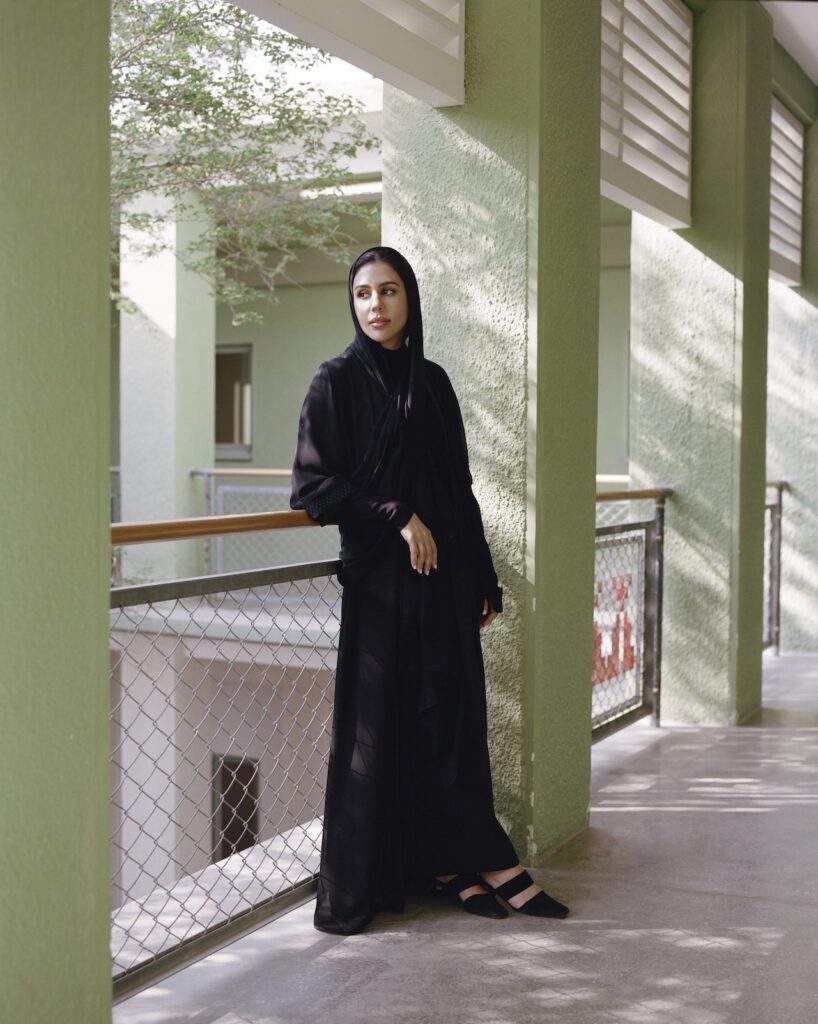
For Sheikha Reem Al Thani, acting deputy chief executive of exhibitions and public art at Qatar Museums, Serra’s installation East-West/West-East, 2014, is one of two “spark moments” that helped ignite the institution’s public art programme. The other sits in Doha, outside Sidra Medicine – the women and children’s medical and research centre – where British artist Damien Hirst’s The Miraculous Journey has catalysed debate about what sculpture can mean and where it belongs since its unveiling in 2013. “The piece draws on how human creation is described in the Qur’an,” notes Sheikha Reem of the sculpture, a sequence of 14 large-scale bronzes that chart human gestation from conception to birth.
The Serra commission, by contrast, helped clarify the desert itself as a place the public could inhabit. In the early 2010s, Sheikha Reem recalls, access to the desert was becoming more contested as environmental protections tightened and there was increasing uncertainty about “what was public and what was private”. The Brouq site, with Sheikha al-Mayassa leading the initiative, was chosen deliberately: a protected landscape “where the desert meets the water”, rich in both natural and historical significance. The installation, Sheikha Reem says, made the idea of public space more legible. “We wanted people to understand that there is a public place you can go and enjoy,” she explains.
That experience captures one of the defining tensions in Qatar’s public art programme: between works that demand a journey and works that meet you in motion. The distinction matters because public art in Qatar is a tool of placemaking, positioned to shape how public space is understood, used and remembered.
Le Pouce, 2019, by French sculptor César Baldaccini is a monumental thumb sculpture in Souq Waqif
At one end of that spectrum sit widely visible works placed in high-circulation settings, such as Swiss artist Urs Fischer’s Lamp/Bear, 2005–06, at Hamad International Airport. At the other are works that might require seeking out. Between those poles are commissions that turn familiar routes into something more charged. Swiss artist Ugo Rondinone’s meditative rock totems by the sea, Doha Mountains, 2022, bring a sense of ceremony to the shoreline: stacked forms that read as both contemporary sculpture and ritualistic cairn, making the edge of Doha feel newly intentional.
Public art here is not always static. Earlier this year, Rirkrit Tiravanija brought a bread-making performance to MIA Park, inviting local and international chefs to bake on site and share bread with the public. “The work is meant to be a place of gathering and crossing in the hope of bringing together the communities who use the park and its various activities,” says the Thai artist. The project is expected to return to Qatar in a new iteration later in the year.
Elsewhere, the programme ranges from Icelandic Danish artist Olafur Eliasson’s intervention in the desert – titled سفر الظلال في بحر النهار (Shadows travelling on the sea of the day), 2022 – to French sculptor César Baldaccini’s monumental thumb in Souq Waqif – Le Pouce, which was installed in 2019 – alongside commissions by Qatari artists such as Shua’a Ali and Aisha Nasser Al Sowaidi.
1361, 1999 by British artist Martin Creed, was installed outside the Sheraton Grand Doha Hotel. Artwork: © 2026 Martin Creed. All Rights Reserved
Sheikha Reem traces public art in Qatar back further than the recent cultural expansion might suggest. In her telling, its origin point is not the contemporary international names newly inscribed on Qatar’s landscape, but something more ordinary: the roundabout.
“Public art emerged in Qatar in the late 1970s and early 1980s,” she says. “At that time, architects – often more so than artists – were commissioned to create forms for roundabouts, drawing on symbolic objects such as a coffee pot or an archway. When we talk about public art, I start there: with something that was ingrained in what we saw growing up.” Those early landmarks were a kind of vernacular public art, embedded in the country’s infrastructure and encountered repeatedly – often without ceremony. The result is a sense of lineage: the idea of art in public space is not foreign to Qatar’s visual memory and these contemporary commissions build on a lived familiarity.
If the earlier era of public art in Qatar was defined by civic markers, the current programme expands the concept across a public realm still being rewritten. In the past decade, infrastructure projects have reshaped how people move through Doha, alongside a renewed interest in architectural restoration and urban regeneration. The city’s cosmopolitan transformation has been swift. The question that follows development is not only what gets built, but how people will interact with it and claim it as their own. Take, for example, Martin Creed’s 1361, 1999, installed outside the Sheraton Grand Doha Hotel, where members of the public act almost like caretakers of the neon work, calling the museum whenever one of the neon letters isn’t working. In its most compelling form, public art is not decoration applied after the fact, but a way of anchoring meaning in a shared space, adding narrative and points of connection.
That ethos found its clearest expression in the lead-up to the 2022 FIFA World Cup, when Qatar Museums treated the tournament as a catalyst for public space itself. Over the course of 2022, more than 40 new public artworks were unveiled across Doha and beyond, positioning sculpture and installation along major routes and gathering points so that art was encountered not as a detour, but as part of movement through the country. The programme did not simply add objects to the landscape – it tested how public art could operate at scale, under the gaze of a global audience.
In Gods We Trust, 2023, is 3D mural in New York by Mexican artist Minerva Cuevas – who is also creating a new work for the National Museum of Qatar metro station.
Photo: Genevieve Hanson, courtesy of the artist and kurimanzutto, Mexico City/New York
One of the commissions began with a pragmatic prompt. The organising committee had produced keychains for accommodation on an industrial scale – and rather than consign them to storage, Qatar Museums turned the surplus into a limited open call. The resulting artwork, Keys to Memories, 2025, by Doha- and Beirut-based Boo Design Studio in collaboration with Qatari artist Maryam Al Homaid, transformed 250,000 reclaimed keychains into a tunnel-like passage outside Lusail Metro Station, on the route to Lusail Stadium, with a pattern that forms a visual representation of fans’ chants in support of the four teams that made the semi-finals.
Sheikha Reem describes it as a work that made public space feel newly usable: the installation provided shading along an exposed stretch, while its text and patterning cast language onto the ground as people walked through. What mattered most, she adds, was seeing behaviour shift in real time – people specifically choosing to pass through it on the way to the metro, turning an improvised reuse project into something closer to infrastructure.
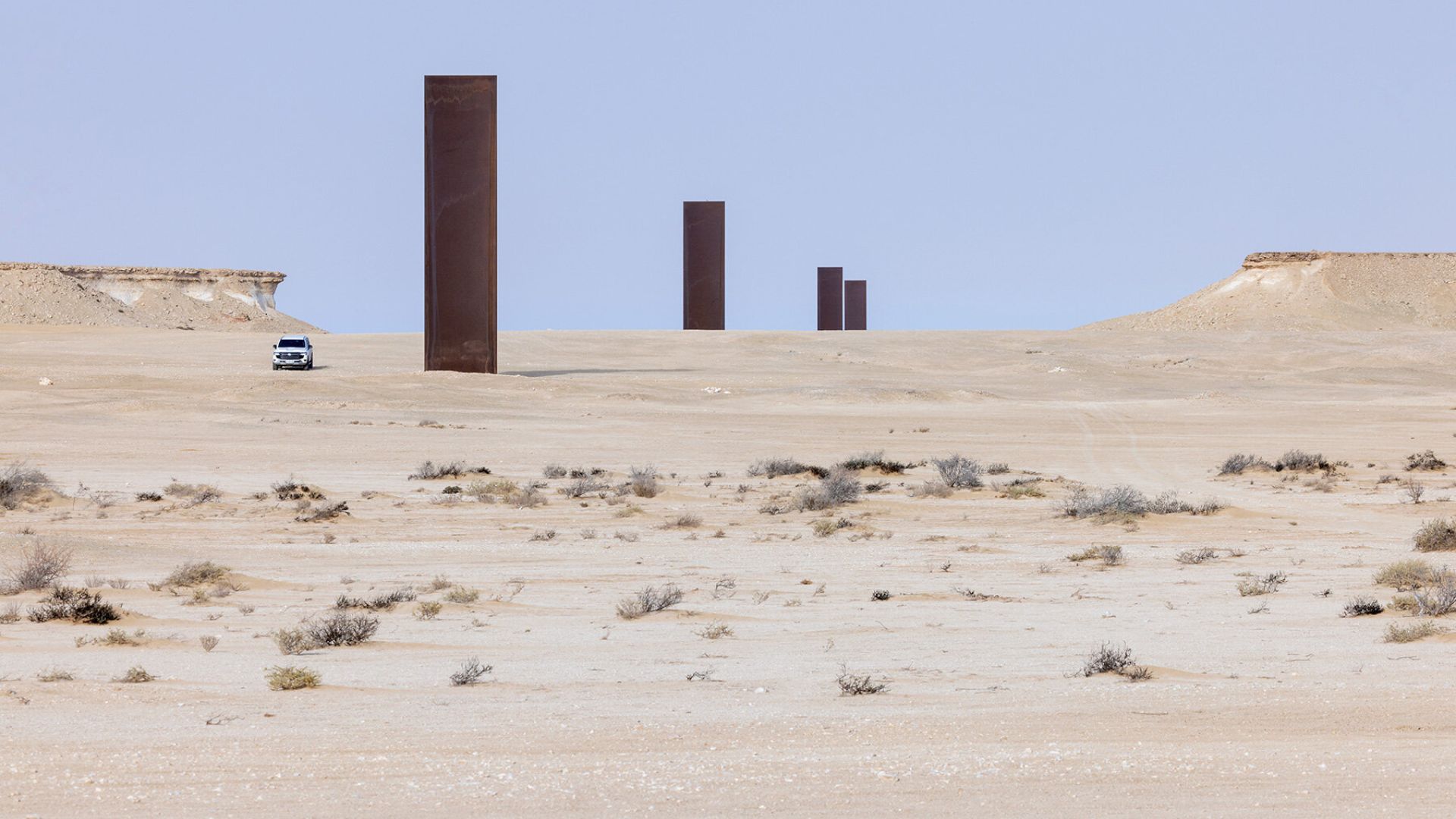
Richard Serra’s installation East-West/West-East, 2014, was one of two “spark moments” that helped ignite Qatar Museums’ public art programme. Photo: © 2026 Estate of Richard Serra/DACS
“Public art emerged in Qatar in the late 1970s and early 1980s... When we talk about public art, I start there”
Sheikha Reem Al Thani
Moments like that get to the heart of how public art accrues meaning. For Sheikha Reem, the life of a work begins long before installation, but it becomes fully itself only once it is absorbed into the rhythms of daily movement. “In the past few years, we have been working with public art across multiple levels,” she says, from local commissioning to placing works “out in the desert, or in the middle of the souq”. Impact is not always visible at the point of creation. “But when you see people engaging with public art, that’s when it really comes to life – how it marks a place, how it changes behaviour.”
Behind that lived experience are decisions that remain largely invisible, but are central to the programme’s logic. There is no single pathway by which public art arrives in Qatar’s streets and landscapes. Some projects begin with open or invitational calls; others are the result of direct commissions. Sometimes a work is drawn from Qatar Museums’ collection and placed into a public space, repositioned to be encountered outside institutional walls. In each case, the route to installation involves a web of conversations between artists, curators, engineers, municipal partners and site stakeholders, alongside research into a site’s history and the layers of meaning a work might carry.
The Miraculous Journey, 2018, by Damien Hirst features 14 enormous bronze sculptures charting the period from conception to birth. Photo: © 2026 Damien Hirst and Science Ltd.
“When you see people engaging with public art that’s when it comes to life... It changes behaviour”
Sheikha Reem Al Thani
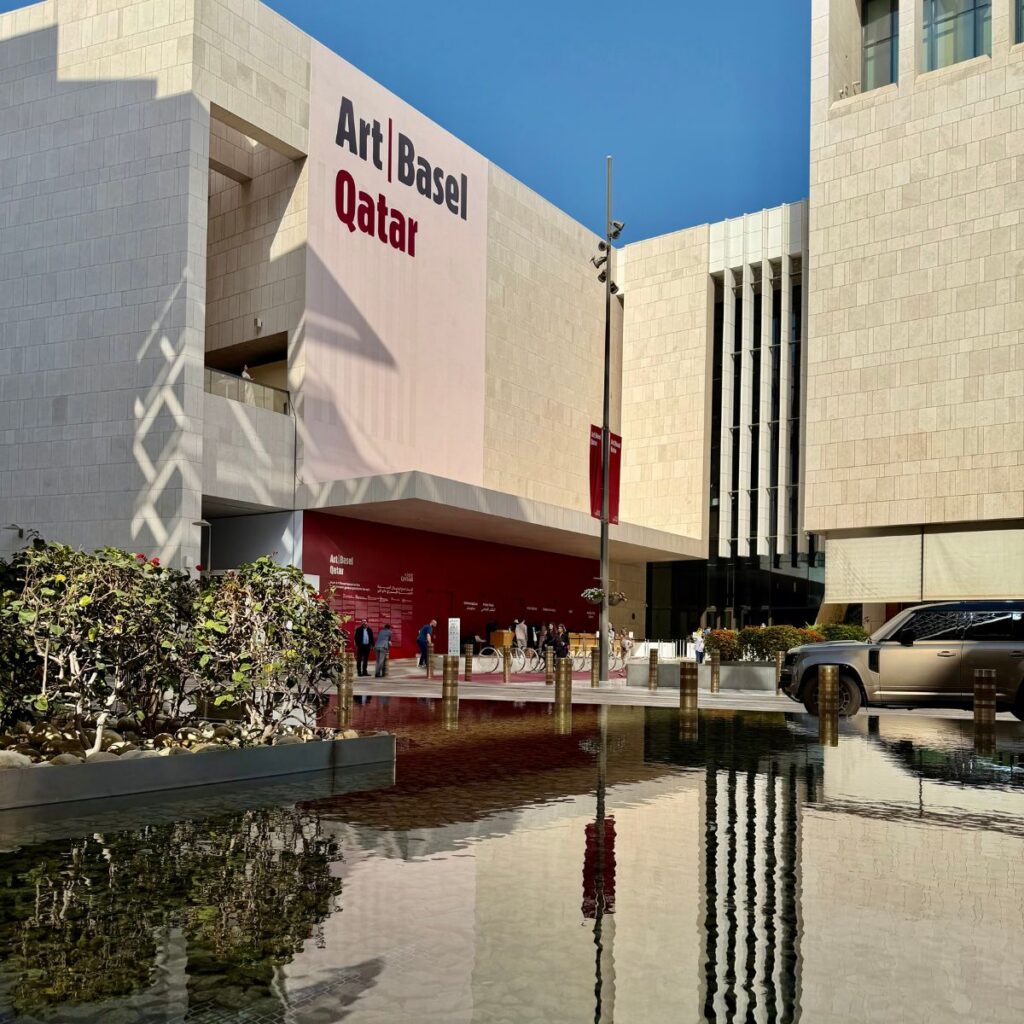
If the public does not shape those early conversations directly, it becomes the central actor once a work is installed. “A theme we discussed during Art Basel Qatar was the public’s relationship with public art and the way people begin to take ownership of a work once it enters their daily lives,” Sheikha Reem says. That ownership, she adds, is the result of intent as much as chance. “There is a great deal of discussion behind the scenes about what each work means and how it connects,” she explains. “How do we add to it curatorially and historically through research, so that it carries the different layers we’ve been talking about?”
The next phase of that thinking arrives through a pipeline of 2026 commissions. The works are shaped by site-led opportunities as well as wider cultural frameworks. Two initiatives provide the programme’s clearest contours: Qatar’s partnership with Canada and Mexico for the Qatar, Canada and Mexico Year of Culture 2026, and Rubaiya Qatar, a nationwide visual arts quadrennial set to debut in November.
Among the public works linked to Rubaiya are a 3D mural by Mexican artist Minerva Cuevas inside the metro station at the National Museum of Qatar, and a work by Indian artist Jitish Kallat on a roundabout at Doha Port using geographic signage to register distances to places around the world. For Kallat, the site is inseparable from the idea. “Qatar sits along historic Indian Ocean trade routes once guided by monsoon winds and navigational stars,” says the artist, adding that the work links today’s migration pathways with older celestial routes, referencing supergiant stars such as Canopus and Polaris.
Taken together, these projects suggest a programme thinking less in isolated objects than in conditions: where a work sits, how it is reached, what pace it asks of you and what kind of attention it can hold. Scale, here, is not only a matter of size or spectacle. A desert pilgrimage can recalibrate the landscape; a work embedded in daily circulation can develop the social texture of a place.
The longer ambition is to build a public art ecology that can be returned to – and lived with – rather than a sequence of one-off statements. That means sustained commissioning alongside stewardship and maintenance, and a programme designed to deepen public engagement as it evolves with Qatar’s swiftly changing cultural profile.